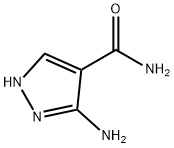
5-Amino-4-pyrazolecarboxamide is used in the synthesis of 4H-3,1-Benzothiazinone analogs as antiproliferative agents against human cancer cell lines. Also, it is an intermediate used in the synthesis of 3-(4H-1,2,4-Triazol-4-yl)-1H-pyrazole-4-carboxamide (T767570), which is an impurity of Allopurinol (A547300), which is a xanthine oxidase inhibitor; decreases uric acid production. Used in treatment of hyperuricemia and chronic gout. Antiurolithic.
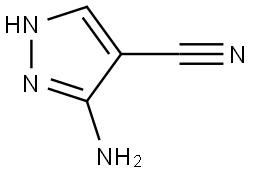
General procedure for the synthesis of 3-aminopyrazole-4-carboxamide from 3-amino-4-cyanopyrazole: 5-amino-1H-pyrazole-4-carbonitrile (1) (5 g, 0.046 mol) was slowly added to pre-cooled concentrated sulfuric acid (10 ml) under stirring conditions, and the temperature of the reaction was controlled not to exceed 20 °C. After the addition was completed, the reaction mixture was stirred continuously at room temperature for 4 hours. Subsequently, the reaction solution was slowly poured into ice water under stirring and the mixture was allowed to stand in a refrigerator overnight. The precipitated solid product was collected by filtration and washed with water to remove residual sulfuric acid, which ultimately yielded the target compound 5-amino-1H-pyrazole-4-carboxamide (2) as a white solid with a yield of 5.19 g in 89% yield; melting point 220-222 °C (literature value 222-225 °C) [33].
[1] Bioorganic Chemistry, 2018, vol. 79, p. 46 - 59
[2] European Journal of Medicinal Chemistry, 2017, vol. 126, p. 24 - 35
[3] Bioorganic and Medicinal Chemistry Letters, 2006, vol. 16, # 5, p. 1191 - 1196