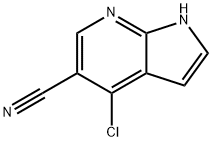
There are many reported methods for constructing the bicyclic parent structure of pyrrolo[2,3-B]pyridine. Using 2,3-dicarboxylic acid pyridine as a raw material, pyrrolopyridine cyclic compounds are prepared by esterification, reduction, chlorination, and then cyclization with sodium hydride and p-toluenesulfonamide. Intramolecular cyclization can also be performed to prepare 4-Chloro-1H-pyrrolo[2,3-b]pyridine-5-carbonitrile. The synthetic reaction formula is shown in the figure below.

Figure 1 Synthesis reaction formula of 4-Chloro-1H-pyrrolo[2,3-b]pyridine-5-carbonitrile
Experimental procedure:
3-acetylen-4-chloropyridine-2-amine-5-carboxynitrile was dissolved in anhydrous methanol, and a catalytic amount of glacial acetic acid was added. 70.0 mg (1.10 mmol) of sodium cyanoborohydride was weighed in N2 gas. The mixture was stirred and heated to 60°C in a flask. The reaction progress was monitored by thin-layer chromatography until no reactants were observed. The reaction was stopped. TLC detection (methanol eluent) showed that the product Rf = 0.57.
The reaction mixture was evaporated to dryness, dissolved in dichloromethane, washed twice with purified water, and the organic phase was dried over anhydrous sodium sulfate. The mixture was then separated by silica gel column chromatography, and the product was dried under vacuum to give 4-Chloro-1H-pyrrolo[2,3-b]pyridine-5-carbonitrile.