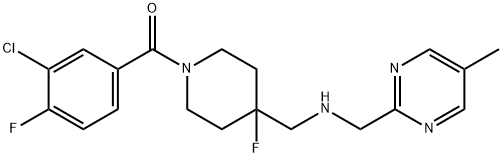
F15599 (0.06 or 0.12 mg/kg) significantly reduces l-DOPA-induced dyskinesia (LID), without affecting motor performance of rats. Rats treated with F15599 manifest less LID and mild 5-HT syndrome with the high dose of 30 μg/μL[1]. F15599 (0.0625, 0.125, 0.25, 0.5 and 1.0 mg/kg, i,p,) results in a significant and dose-dependent (MED=0.125 mg/kg) delay in the latency to attack, and a potent reduction (ID50=0.095 mg/kg) in the amount of aggressive behaviour directed towards the intruder rat. Starting from the 0.25 mg/kg dose, F15599 induces clear signs of the so-called serotonin syndrome characterized by flat body posture, head-waving, lower lip retraction and hindlimb abduction, leading to increased behavioural inactivity scores and social disengagement[2]. F15599 increases the discharge rate of pyramidal neurones in medial prefrontal cortex (mPFC) from 0.2 μg/kg i.v and reduces that of dorsal raphe 5-hydroxytryptaminergic neurones at doses >10-fold higher (minimal effective dose 8.2 μg/kg i.v.). F15599 increases dopamine output in mPFC (an effect dependent on the activation of postsynaptic 5-HT1A receptors) with an ED50 of 30 μg/kg i.p., whereas it reduces hippocampal 5-HT release (an effect dependent exclusively on 5-HT1A autoreceptor activation) with an ED50 of 240 μg/kg i.p[3].