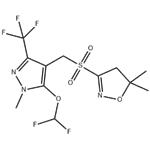
Pyroxasulfone is commercially synthesised through a multi-step process that builds its unique isoxazoline-sulfonyl-pyrazole structure. The synthesis typically begins with the preparation of a substituted pyrazole intermediate, such as 5-(difluoromethoxy)-1-methyl-3-(trifluoromethyl)-1H-pyrazol-4-ylmethanol, which is then reacted with a sulfonylating agent and coupled to a dimethylisoxazoline moiety. This process involves selective fluorination, methylation, and sulfonylation steps under controlled conditions to ensure high purity and herbicidal efficacy.

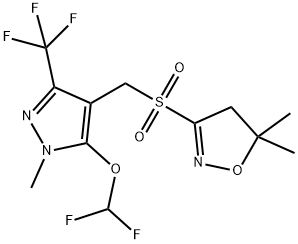
![3-({[5-(difluoromethoxy)-1-methyl-3-(trifluoromethyl)-1H-pyrazol-4-yl]methyl}sulfonyl)-5,5-dimethyl-4,5-dihydro-1,2-oxazole pictures](/ProductImageEN1/2025-04/Small/419379b4-57fb-4807-8323-e1fae2e4ce5d.gif)