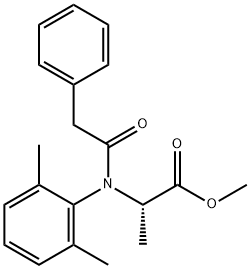
Benalaxyl is a fungicide that is widely used but now being phased out in many countries. It has a moderate aqueous solubility, is quite volatile and a low potential for bioaccumulation. It is non-mobile, moderately persistent in soil systems but may be persistent in water systems. It is moderately toxic to mammals but would not be expected to bioaccumulate. It is moderately toxic to most aquatic organisms, honeybees and earthworms but less so to birds.
The pure product is a colorless solid. MPa 78-80°C, relative density 1.27 (25°C), vapor pressure 0.67×10⁻³ Pa (25°C). Solubility at 25°C: acetone >500 g/kg, chloroform >500 g/kg, cyclohexanone >400 g/kg, hexane <50 g/kg, xylene >300 g/kg, dimethylformamide >500 g/kg, water 37 mg/L. Partition coefficient 2500. It is stable to heat and light and is stable in buffer solutions with a pH of 4-9. It readily hydrolyzes in concentrated alkaline media.
An acylamino acid fungicide.
Benalaxyl is used for the control of Oomycetes on a wide range
of crops, fruit, flowers, ornamentals and turf.
ChEBI: Methyl N-(2,6-dimethylphenyl)-N-(phenylacetyl)alaninate is an alanine derivative that is the N-phenylacetyl derivative of methyl N-(2,6-dimethylphenyl)alaninate It is an alanine derivative, an aromatic amide, a carboxamide and a methyl ester.
Benalaxyl is commercially produced through a multi-step chemical synthesis process, beginning with the formation of its core phenylamide structure. The active ingredient, methyl N-phenylacetyl-N-2,6-xylyl-DL-alaninate, is synthesized by reacting phenylacetic acid derivatives with substituted xylylamine and alanine esters under controlled conditions. This process yields a racemic mixture of enantiomers, typically formulated as a suspension concentrate or granules for agricultural use.
Systemic with protective, curative and eradicant action. Disrupts fungal nucleic acid synthesis - RNA ploymerase 1
The fate of 14C-benalaxyl as affected by mancozeb is
determined on the surface and in the tissues of grape
leaves 7 days after the single foliar application of a
mixture with mancozeb. The main oxidative scheme
with rat liver microsomes is quite similar to that
observed in plants. The only differences are
represented by a further hydroxylation on the second
ortho methyl group, and only traces of the meta
hydroxylation take place on the xylene ring.
Benalaxyl is stable in aqueous media over a wide pH range but it is hydrolysed
in concentrated alkali. Its DT50 at pH 9 and 25 °C is 86 days (PM).
It is reasonably stable to sunlight in aqueous solution. When irradiated
in solution with UV light (254 nm) it is degraded with a half-life of
55 minutes (Pirisi et al., 1996). Products were compounds 2 and 3 (see
Scheme 1) which are common also to metalaxyl and furalaxyl. These
were detected in a non-labelled study. Under simulated sunlight its
half-life was 167 days.