Silithiamide is white granular solid, melting point is 86.1~88.3℃, vapor pressure(20℃)8.1×10mPa. kow lgP=3.72(20℃), Henry's constant 5.4×10⁻¹ Pa -m3/ mol, relative density 1.07(20℃). Solubility in water (20°C) 39.9 mg/L. Solubility in organic solvents (20°C, g/L): n-heptane 15.5, xylene, 1,2-dichloromethane, methanol, acetone, and ethyl acetate were all greater than 250. Stability DT50 (25°C): 6ld (pH 5), 448d (pH 7), 314d (pH 9).
Silthiofam is a fungicide. It is derived from 3-Chloro-2-butanone (C366895), which is widely used in the chemical and pharmaceutical industries as an intermediate or starting material (for example its use in a one-pot synthesis of γ-iminolactones). Also, it is derived from 2-Amino-4,5-dimethyl-3-thiophenecarboxylic Acid Ethyl Ester (A605165), which is used in the preparation triazine and pyrimidine derivatives as anti-inflammatory and analgesic agents. Also used in the synthesis of antioxidants through heteroaryl amines as well as CB2 cannabinoid receptor partial agonists.
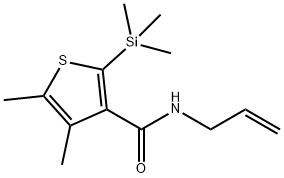
ChEBI: A monocarboxylic acid amide obtained by formal condensation of the carboxy group from 4,5-dimethyl-2-(trimethylsilyl)thiophene-3-carboxlic acid with the amino group of allylamine. A fungicide seed dressing for cereals used mainly to control 'take-all'.
Protective action with long-lasting activity. Respiration inhibitor - ATR production.
Silthiofam is synthesized in three steps. 1) Preparation of methyl trimethylsilylpropynoate: Trimethylsilylacetylene reacts with n-butyllithium, then with methyl chloroformate. Work-up and purification yield the product. 2) Preparation of methyl 4,5-dimethyl-2-(trimethylsilyl)thiophene-3-carboxylate: The product from step 1 reacts with 3-mercapto-2-butanone in toluene with sodium methoxide under reflux. Work-up and purification give the product. 3) Preparation of the final product: The ester from step 2 reacts with excess allylamine catalyzed by TBD under heating and reflux. Work-up yields silthiofam.