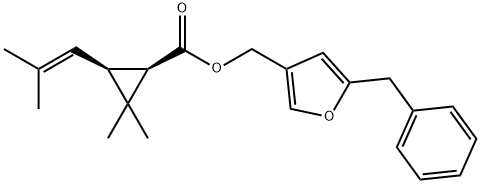
Cis-benzylfuran and bio-benzylfuran, when used as contact aerosols, generally exhibit toxicity 1-2 orders of magnitude higher than organophosphate insecticides against adult females of *Aedes aegypti*, *Aedes aegypti*, *Culex pipiens*, *Anopheles tetrastigma*, and *Anopheles pallens*. Non-thermal aerosol spraying using light oil as a medium can effectively control adult *Aedes aegypti*. A concentration of 0.01 mg/kg of this product can control 4th instar larvae of *Aedes aegypti*, *Culex pipiens*, and *Anopheles pallens*. In field ponds, a dosage of 0.28 kg/hm² can control larvae and pupae of *Culex pipiens*. In a laboratory chamber, spraying 0.1% of this product's oil formulation showed a KT of 3.7 min and a 24-hour mortality rate of 98% against adult mosquitoes. This product and permethrin are most effective against the nymphs of the red-skinned tick. The average lethal concentration after 24 hours of immersion in the solution is 0.3 mg/kg for the former and 0.47 mg/kg for the latter, making the former more effective than permethrin.
Off-white to tan waxy solid or colorless crys-
tals. Chrysanthemum-like odor. Commercial products may
be dissolved in flammable organic solvents
Production of cismethrin follows the general industrial pathway used for pyrethroid chrysanthemate esters. Production begins with the preparation of the acid component, typically a chrysanthemic acid derivative, and the alcohol component, which in this case is the (5 benzyl 3 furyl)methanol moiety. These two components are then brought together in a controlled esterification reaction, often using acid chlorides or dehydrating agents to ensure high conversion to the desired ester. Because cismethrin’s insecticidal activity depends heavily on its stereochemistry, manufacturers use carefully regulated reaction conditions and purification steps to maximize formation of the (1R,cis) configuration and minimize other isomers. After esterification, the crude product is purified, typically by distillation or crystallisation, to remove unreacted precursors and by products, yielding the final technical grade insecticide used in formulations.
Contact, rapid knockdown action acting on the insects nervous system. Sodium channel modulator.
Resmethrin is pyrethroid insecticide
used for mosquito control (by aerial application) in the
USA, and may can also be used in greenhouses to control
white fly. Resmethrin is a synthetic Type I pyrethroid
insecticide registered for control of insects in residential,
commercial, and industrial settings, and in animal living
areas. It is also registered for use in food handling estab-
lishments and as a restricted use pesticide when used in
ULV spray to control adult mosquitoes in the interest of
public health . A United States Restricted Use Pesticide
(RUP) when formulated for use in mosquito abatement and
pest control treatments at nonagricultural sites. Restricted
due to extreme fish toxicity.
UN3352 Pyrethroid pesticide, liquid toxic,
Hazard Class: 6.1; Labels: 6.1-Poisonous materials.
UN3349 Pyrethroid pesticide, solid toxic, Hazard Class:
6.1; Labels: 6.1-Poisonous material
Decomposed by air, light, alkaline
media, and temperatures .175℃. May react violently with
strong oxidizers, bromine, 90% hydrogen peroxide, phos-
phorus trichloride, silver powders or dust. Incompatible
with silver compounds. Mixture with some silver
compounds forms explosive salts of silver oxalate.
Incineration would be an
effective disposal procedure where permitted. If an efficient
incinerator is not available, the product should be mixed with large amounts of combustible material and contact
with the smoke should be avoided. In accordance with
40CFR165. Follow recommendations for the disposal of
pesticides and pesticide containers . Bury in noncrop
land away from water. It would be better to mix the prod-
uct with lime. Incineration would be an effective disposal
procedure where permitted. If an efficient incinerator is not
available, the product should be mixed with large amount
of combustible material. Recommendable methods:
Hydrolysis, landfill, incineration, and open burning. Not
recommendable method: Discharge to sewer. Mix with saw-
dust and burn at a remote place .