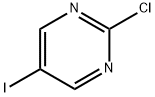
In organic synthesis, 2-chloro-5-iodopyrimidine can be used to synthesize other compounds containing pyrimidine ring structures, and it can also be used in coordination chemistry, organic electronic devices and other fields.
Step A. Preparation of 2-chloro-5-iodopyrimidine
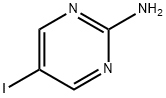
To a stirred solution of 5-iodopyrimidin-2-amine (2.21 g, 10.0 mmol) in acetonitrile (20 mL) was sequentially added copper(II) chloride (2.02 g, 15 mmol) and tert-butyl nitrite (1.55 g, 15 mmol) at room temperature and under argon protection. The reaction mixture was transferred to an oil bath preheated to 60 °C and reacted under argon atmosphere. After completion of the reaction, the mixture was cooled to room temperature and diluted with the addition of ether (20 mL). The insoluble material was removed by filtration and the filtrate was concentrated under reduced pressure. The crude product was dissolved in a small amount of dichloromethane (about 2 mL) and purified by passing through an 80 g ISCO silica gel column using a 20 min gradient elution (0% to 100% ethyl acetate/hexane). 2-Chloro-5-iodopyrimidine (778 mg, 31% yield) was finally obtained as an off-white solid.1H NMR (400 MHz, CDCl3) δ 8.79 (s, 2H).
[1] Journal of Organic Chemistry, 2008, vol. 73, # 23, p. 9326 - 9333
[2] Patent: WO2010/9183, 2010, A1. Location in patent: Page/Page column 79
[3] Patent: US4248618, 1981, A
[4] Patent: WO2013/186692, 2013, A1. Location in patent: Page/Page column 62