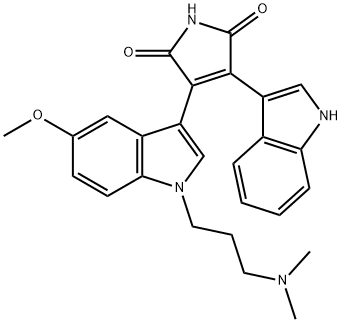
Go-6983 (133053-19-7) potent and pan-specific, ATP-competitive protein kinase C inhibitor. PKC isotype IC50s= 7, 7, 6, 10 and 60 nM for PKC α, β, γ, δ, ζ respectively.1 Suppresses stress induced HSP27 disassociation.2 Maintains rat embryonic stem cell pluripotency.3 Attenuates myocardial ischemia/reperfusion injury.4
Go 6983, is a protein kinase C (PKC) inhibitor.Potent PKC Inhibitor
GO6983 has been used as a protein kinase C (PKC) inhibitor to study its effects on the nuclear import. It has also been used as a supplement in Fc medium to culture mouse embryonic stem (mES) cells on mitomycin C treated mouse embryonic fibroblasts (MEFs).
ChEBI: 3-[1-[3-(dimethylamino)propyl]-5-methoxy-3-indolyl]-4-(1H-indol-3-yl)pyrrole-2,5-dione is a member of indoles and a member of maleimides.
Broad spectrum protein kinase C (PKC) inhibitor (IC 50 values are 7, 7, 6, 10, 60 and 20000 nM for PKC α , PKC β , PKC γ , PKC δ , PKC ζ and PKC μ respectively). Displays cardioprotective properties; reduces polymorphonuclear leukocyte adherence and infiltration following myocardial ischemia/reperfusion injury.
Protein kinase C (PKC) inhibitor that selectively inhibits several PKC isozymes (IC50 = 7 nM for PKCα and PKCβ; 6 nM for PKCγ; 10 nM for PKCδ; and 60 nM for PKCζ), but does not inhibit PKCμ (IC50 = 20 mM).
[1] MICHAEL GSCHWENDT . Inhibition of protein kinase C μ by various inhibitors. Inhibition from protein kinase c isoenzymes[J]. FEBS Letters, 1996, 392 2: Pages 77-80. DOI:
10.1016/0014-5793(96)00785-5[2] KANEFUSA KATO. Protein kinase inhibitors can suppress stress-induced dissociation of Hsp27[J]. Cell Stress & Chaperones, 2001, 18 1: 16-20. DOI:
10.1379/1466-1268(2001)006<0016:pkicss>2.0.co;2[3] GANESHKUMAR RAJENDRAN. Inhibition of protein kinase C signaling maintains rat embryonic stem cell pluripotency.[J]. The Journal of Biological Chemistry, 2013: 24351-24362. DOI:
10.1074/jbc.m113.455725[4] LINDON H. YOUNG Margaret T W Brian J Balin. Gö 6983: A Fast Acting Protein Kinase C Inhibitor that Attenuates Myocardial Ischemia/Reperfusion Injury[J]. Cardiovascular Therapeutics, 2006, 23 3: 255-272. DOI:
10.1111/j.1527-3466.2005.tb00170.x