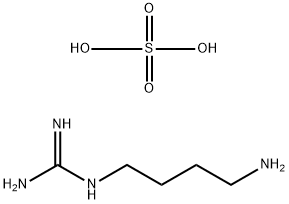
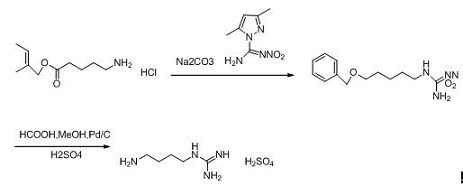
Route 1: Using 1,4-butanediamine as a starting material, it is first protected with a monoamine group, then nitrified with 1-nitroguanidinyl-3,5-dimethylpyrazole to nitrify the other amine group. Following reduction, deprotection, and salt formation, Agmatine sulfate is finally obtained. See the figure below:
Route 2: First, diethyl adipate reacts with hydrazine hydrate to obtain adipate dihydrazide, which then reacts with sodium nitrite to obtain a diazonium salt. Heating removes nitrogen to generate 1,4-diisocyanate butane, which is hydrolyzed to obtain the key intermediate 1,4-butanediamine. This intermediate then reacts with S-methylisothiourea sulfate to obtain Agmatine sulfate. The specific reaction process is as follows:
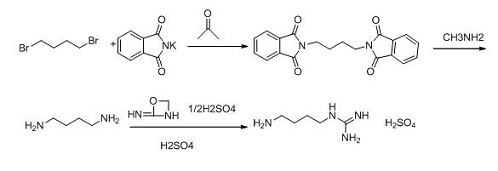
Route 4: Using 1,4-butanediamine as a starting material and S-methylisothiourea sulfate as a guanidinizing agent, the reaction is shown below:
Route 5: Using 1,4-butanediamine as a starting material and cyanamide aqueous solution as a guanidinizing agent, guanidinobutylamine is obtained through an addition reaction, followed by salt formation with sulfuric acid, yielding:
Route 5: Using 1,4-butanediamine as a starting material and cyanamide aqueous solution as a guanidinizing agent, guanidinobutylamine is obtained through an addition reaction, followed by salt formation with sulfuric acid, yielding:
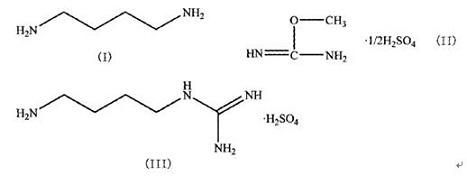
Route 5: Using 1,4-butanediamine as a starting material and cyanamide aqueous solution as a guanidinizing agent, guanidinobutylamine is obtained through an addition reaction, followed by salt formation with sulfuric acid, yielding: Route 6: A method for synthesizing Agmatine sulfate, comprising the following steps: 1,4-Butanediamine and O-methylisourea sulfate undergo a condensation reaction in a reaction solvent at -20 to 100°C. The reaction is monitored by TLC until the endpoint is reached. The reaction solution is filtered, and an alcoholic solution of sulfuric acid is added dropwise to the filtrate to adjust the pH to below 7.0. The filtrate is concentrated to dryness, and the residue is recrystallized to obtain Agmatine sulfate. The reaction solvent is water or a C1-C3 alcohol. The molar ratio of 1,4-butanediamine to O-methylisourea sulfate is 1:1 to 1:2.0. The volumetric amount of the reaction solvent, based on the mass of O-methylisourea sulfate, is 4-20 ml/g. This invention is simple and safe to operate, has a high reaction yield, low production cost, and virtually no emissions of waste, demonstrating significant practical value and socio-economic benefits. The specific reaction process is as follows:
Route 7: A biotransformation method for Agmatine sulfate, comprising: using L-arginine as a substrate and arginine decarboxylase as a biotransformation catalyst, performing a decarboxylation reaction to generate crude guanidinobutylamine product, and acidifying the crude guanidinobutylamine product with dilute sulfuric acid to obtain crude Agmatine sulfate. The method has a simple process flow, requires no special equipment, and is suitable for industrial production. Compared with purely chemical methods, this method has milder reaction conditions, is easier to operate, has lower costs, less pollution, and can complete enzymatic catalytic reactions that are difficult to perform in chemical reactions.