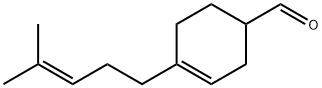
MYRAC ALDEHYDE can be used in citrus, fruity, and many floral fragrances. It has a significant impact on bergamot and other citrus scents, including aldehyde top notes. Because it is more stable than most aliphatic aldehydes, it has a wider range of applications. It is excellent for scenting soaps and can enhance the freshness of everyday fragrances such as pine needle, lily of the valley, violet, and lilac. It can also be used as a masking agent for unpleasant industrial odors. It blends well with ionone and cyclohexyl derivatives of cypress wood. The dosage in fragrances can reach 5%–10%. It is generally not used for food.
MYRAC ALDEHYDE is prepared, together with its 3-isomer, by a Diels–Alder
reaction ofmyrcene and acrolein.Themixture, d20
4 0.927–0.935, n20
D 1.488–1.492,
has a fresh, fruity, slightly citrus-like odor and is used to perfume household products.
Has apparently not been reported to occur in nature
ChEBI: 4-(4-Methyl-3-pentenyl)-3-cyclohexene-1-carboxaldehyde is a monoterpenoid.
From myrcene and acrolein (Arctander, 1969).
Low toxicity by ingestion. A moderate skin
and mild eye irritant.
Myrac aldehyde (IFF), Myraldene (Givaudan), Myracal (DRT).