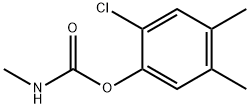
Carbanolate is an obsolete carbamate insecticide. It has a moderate aqueous solubility. There are significant gaps in reported data for environmental fate and ecotoxicity. However, it is highly toxic to mammals and likely to bioaccumulate. It is also a neurotoxin and an acetyl cholinesterase inhibitor.
2-Chloro-4,5-dimethylphenyl methylcarbamate is a pesticide.
ChEBI: Carbanolate is a carbamate ester that is phenyl methylcarbamate which is substituted by a chloro group at position 2 and by methyl groups at positions 4 and 5, respectively. It is an insecticide used in the the control of poultry ectoparasites. It has a role as a carbamate insecticide, an EC 3.1.1.7 (acetylcholinesterase) inhibitor and an acaricide. It is a member of monochlorobenzenes and a carbamate ester.
Carbanolate is typically synthesised through a chemical reaction between 1-naphthol and methyl isocyanate or methylcarbamoyl chloride. These reagents introduce the carbamate functional group onto the aromatic ring, forming the active insecticidal compound. The process involves careful control of temperature and pH to ensure selective esterification and minimise by-products. Due to the toxicity of intermediates like methyl isocyanate, modern production methods often seek safer alternatives or closed-system reactors to reduce exposure risks.
Acetylcholinesterase (AchE) inhibitor
Insecticide; Acaricide; Veterinary substance