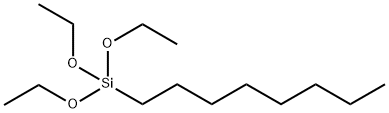
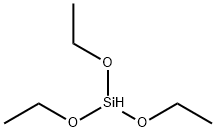
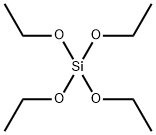
The typical experimental procedure (Table 2, entry 1) was as follows: Ni(acac)2 (1a) (1.3 mg, 0.005 mmol) was dissolved in THF (5 mL) at room temperature, and 1-octene (112 mg, 1.0 mmol) and triethoxysilane (164 mg, 1.0 mmol) were added sequentially under stirring. After stirring the mixed solution for 1 min, NaBHEt3 (1.0 M in THF, 5 mL, 0.005 mmol) was added and the reaction mixture was subsequently heated to 50 °C. This temperature was maintained and the reaction progress was monitored by gas chromatography (GLC). Upon completion of the reaction, homotrimethylbenzene (60 mg, 0.50 mmol) was added to the mixture as an internal standard.GLC analysis showed the products to be n-octyltriethoxysilane (0.90 mmol, 90%) and tetraethyl silicate (0.05 mmol, 5%). The reaction solution was concentrated under vacuum and the residue was purified by gel permeation chromatography (GPC) using toluene as eluent to give n-octyltriethoxysilane (234 mg, 0.85 mmol, 85%). The 1H, 13C{1H} and 29Si{1H} NMR spectra of the isolated compounds were in agreement with the data reported in the literature. Similar methods were applied to the hydrogenosilylation of other silanes with 1,3-dienes/olefins/alkynes, except for the reactions, which were carried out at room temperature (Table 2, entries 2-3). The 1H/13C NMR spectral data of the new compounds are detailed in the Supplementary Material.