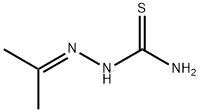
Acetone thiosemicarbazide is a white to yellow crystalline solid with highly toxic.
Acetone thiosemicarbazone(ATSC) is a termination agent capable of rapidly halting reactions in PVC production processes, making it suitable for the suspension polymerisation of polyvinyl chloride resin.
Synthesis of Acetone Thiosemicarbazone (ACTSC):Thiosemicarbazide (0.01 mol, 0.182 g) was dissolved in methanol (30 mL) under reflux at 50 °C. To this refluxing solution, a solution of acetone (0.1 mol, 0.87 mL) in methanol (30 mL) was added, followed by a few drops of concentrated HCl. The reaction mixture was stirred and refluxed continuously for 4 hours at 60 °C. The volume of the mixture was then reduced, and the solution was cooled in an ice-water bath. The precipitated crystals of acetone thiosemicarbazone were collected, washed with methanol, and dried in a desiccator over silica gel.
Acetone thiosemicarbazone may form toxic gases with acids, aldehydes, amides, carbamates, cyanides, inorganic fluorides, halogenated organics, isocyanates, ketones, metals, nitrides, peroxides, phenols, epoxides, acyl halides, and strong oxidizing or reducing agents. May form flammable gases with alkali metals. Explosive combination may occur with strong oxidizing agents, metal salts, peroxides, and sulfides. Emits toxic fumes of oxides of sulfur and nitrogen when heated to decomposition [Sax, 9th ed., 1996, p. 3165].
When heated to decomposition, Acetone thiosemicarbazone emits very toxic fumes of nitrogen oxides and sulfur oxides. Avoid decomposing heat.
Acetone thiosemicarbazone is used as an intermediate in the manufacture of pharmaceuticals and pesticides. May be used as an agricultural chemical.
UN2811 Toxic solids, organic, n.o.s., Hazard Class: 6.1; Labels: 6.1-Poisonous materials, Technical Name Required.
Incompatible with oxidizers (chlorates, nitrates, peroxides, permanganates, perchlorates, chlorine, bromine, fluorine, etc.); contact may cause fires or explosions. Keep away from alkaline materials, strong bases, strong acids, oxoacids, epoxides
It is inappropriate and possibly dangerous to the environment to dispose of expired or waste drugs and pharmaceuticals by flushing them down the toilet or discarding them to the trash. Household quantities of expired or waste pharmaceuticals may be mixed with wet cat litter or coffee grounds, double-bagged in plastic, discard in trash. Larger quantities shall carefully take into consideration applicable DEA, EPA, and FDA regulations. If possible return the pharmaceutical to the manufacturer for proper disposal being careful to properly label and securely package the material. Alternatively, the waste pharmaceutical shall be labeled, securely packaged and transported by a state licensed medical waste contractor to dispose by burial in a licensed hazardous or toxic waste landfill or incinerator.
[1] KPOMAH B, EGBOH S, AGBAIRE P O, et al. Metal Complexes of Acetone Thiosemicarbazone: Synthesis, Spectral Characterization and Pharmacological Studies[C]. 2016: 0. DOI:
10.18576/JPAC/020203.
[2] PRIYA P. NETALKAR Vidyanand K R Sandeep P Netalkar. Transition metal complexes of thiosemicarbazone: Synthesis, structures and invitro antimicrobial studies[J]. Polyhedron, 2015, 100: Pages 215-222. DOI:
10.1016/j.poly.2015.07.075.