A sulfur-based, chain-transfer agent providing a high degree of control for living radical polymerizations utilizing the RAFT (reversible addition-fragmentation chain-transfer polymerization) technique.
The trithiocarbonates have a structure that contains three sulfur atoms.
All three sulfur atoms can participate in bonding to the mineral surfaces. Philips
Petroleum Company did most of the development of this class of collectors. Monoalkyl
trithiocarbonate (Orfom 800 series) is used as a collector in flotation of copper and
copper–lead ores.
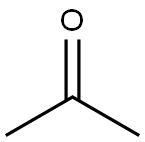
The general procedure for the synthesis of 2-[dodecylthio(thiocarbonyl)thio]-2-methylpropanoic acid from carbon disulfide, trichloromethane, acetone and n-dodecanethiol was as follows: n-dodecanethiol (0.1 mol) and Aliquot 336 (0.004 mol) were dissolved in 48 g of acetone. Subsequently, 50% sodium hydroxide solution (0.105 mol) was added, followed by slow dropwise addition of carbon disulfide (0.1 mol) to 10 g of acetone solution. The reaction mixture gradually changed from colorless to yellow. After 20 minutes of reaction, trichloromethane (0.15 mol) was added followed by dropwise addition of 50% NaOH solution (0.5 mol) and 5 g NaOH beads. The reaction mixture was stirred at 15-20 °C overnight, after which filtration was performed and the filtrate collected. The solid residue was washed with acetone. The acetone layer was concentrated to dryness. The resultant was dissolved in water and acidified with concentrated hydrochloric acid to precipitate out the product, followed by washing with water to collect the yellow solid. The solid was dissolved in 350 mL of hexane and the solution was dried with magnesium sulfate and filtered. The organic solution was cooled to allow the product to precipitate as yellow flakes. The final yield was 85%.
[1] Patent: US2004/73056, 2004, A1. Location in patent: Page 21
[2] Journal of Polymer Science, Part A: Polymer Chemistry, 2010, vol. 48, # 16, p. 3573 - 3586
[3] Chemical Communications, 2014, vol. 50, # 68, p. 9722 - 9724
[4] Soft Matter, 2011, vol. 7, # 22, p. 10763 - 10772
[5] Macromolecules, 2012, vol. 45, # 12, p. 4966 - 4977





![2-Methyl-2-[(dodecylsulfanylthiocarbonyl)sulfanyl]propanoic acid pictures](/ProductImageEN1/2025-06/Small/7e19e08d-c2df-48a9-ad51-1a6e318f6e75.png)