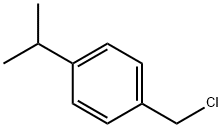
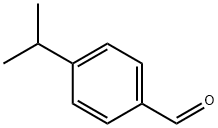
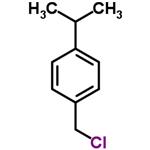
The general procedure for the synthesis of p-isopropylbenzyl chloride from 4-isopropylbenzaldehyde was as follows: 500 ml of methanol was added slowly and dropwise over a period of 5 h to 1000 ml of THF solution containing 148 g (1.0 mol) of 4-isopropylbenzaldehyde and 37.8 g (1.0 mol) of NaBH4 at 0-5 °C, while vigorous stirring was maintained. The reaction mixture was continued to be stirred at room temperature overnight, followed by evaporation of the solvent under vacuum. The residue was acidified to pH~1 with 1200 ml of 2M HCl solution, followed by extraction of the resulting (4-isopropylphenyl) methanol with 3 x 400 ml of dichloromethane. The organic extracts were combined, dried with Na2SO4 and evaporated to dryness. The resulting residue was dissolved in 1000 ml of dichloromethane and 73 ml (1.0 mol) of thionyl chloride was added slowly and dropwise at +5 °C. The reaction solution was stirred overnight at room temperature and evaporated to dryness and the residue was dissolved in 750 ml of dichloromethane. This solution was washed with 250 ml of water and after separating the organic layer, the aqueous layer was then extracted with 2 x 150 ml of dichloromethane. All organic extracts were combined, dried over Na2SO4, filtered through a short silica gel pad (40-63 μm) and finally evaporated to dryness. The crude product was distilled under vacuum to give 142 g (84% yield) of colorless liquid with a boiling point of 107-112°C/15 mmHg.