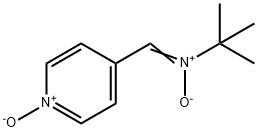
white to pale yellow crystalline powder
POBN is a cell permeable hydrophilic spin trap for in vitro studies. It is a water soluble analog of PBN with low paramagnetic impurities and does not require any further purification. POBN has also also been used in studies of DNA methylation, iron-mediated polyunsaturated fatty acid peroxidation, and free-radical formation by Alzheimer β-amyloid peptide.
Spin trap reagent used to measure ethanol oxidation to 1-hydroxyethyl radical (HER) which can bind to protein. Has also been used in studies of DNA methylation, iron-mediated polyunsaturated fatty acid peroxidation, and free-radical formation by Alzheimer β-amyloid peptide. The formation of hydroxyl radical in chondrocytes and cartilage has been detected using POBN.
Electron spin resonance (ESR) spectrum of radical adducts detected in bile of rats 1 h after acute Sodium formate (2 g/kg) and POBN (1.5 g/kg) i.p. administration[1].
| Animal Model: | Fischer male rats (300-400 g)[1] |
| Dosage: | 1.5 g/kg (Pharmacokinetic Analysis) |
| Administration: | Injected simultaneously i.p. |
| Result: | A strong six-line ESR signal of the POBN radical adduct was detected in the bile of rats after acute sodium formate poisoning. |