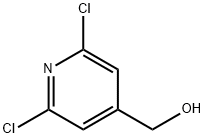
2,6-Dichloro-4-pyridinemethanol is a reagent in the preparation of functionalized compounds such as bipyridines and terpyridines via Stille-type cross coupling. Also used in the preparation of fluorescent chemosensors.
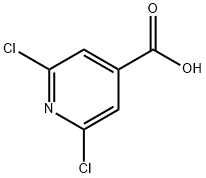
The general procedure for the synthesis of 2,6-dichloropyridine-4-methanol from 2,6-dichloroisonicotinic acid was as follows: Preparation of Intermediate 3.1: To a stirred solution of 2,6-dichloroisonicotinic acid (10.0 g, 52.1 mmol) in THF (300 mL) at 0 °C was slowly added sulfadimethane-borane (1:1) complex (16.0 g, 210.5 mmol) to the THF solution. The reaction mixture was stirred at room temperature overnight. Subsequently, MeOH (22 mL) was carefully added to the stirred mixture under cooling in an ice bath. The reaction mixture was diluted with ethyl acetate (300 mL) and washed sequentially with 1N aqueous sodium hydroxide solution (100 mL) and saturated aqueous sodium chloride solution. The organic layer was concentrated and the residue was purified by silica gel column chromatography (eluent ratio: hexane/ethyl acetate = 7:1 to 3:1) to afford the target product 2,6-dichloropyridine-4-methanol (8.3 g, 46.6 mmol). The product was characterized by 1H NMR (300 MHz, CDCl3, 300 K): δ = 7.25 (2H); 4.72 (2H); 2.24 (1H).
[1] Journal of the American Chemical Society, 2005, vol. 127, # 29, p. 10124 - 10125
[2] Chemical Communications, 1998, # 15, p. 1567 - 1568
[3] Organic Letters, 2010, vol. 12, # 5, p. 940 - 943
[4] Journal fuer Praktische Chemie (Leipzig), 1938, vol. <2> 151, p. 65,79
[5] Tetrahedron, 2007, vol. 63, # 2, p. 291 - 298