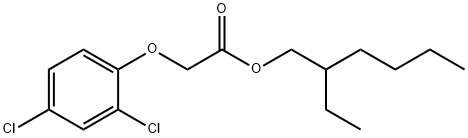
The commercial production of 2,4-D-etexyl begins with purified 2,4 D acid, obtained via the standard phenoxyacetic acid synthesis. That acid is then converted into an activated intermediate, typically an acid chloride or another reactive derivative, so it can couple efficiently with the etexyl alcohol component. Under controlled, non aqueous conditions, the activated acid and the alcohol are brought together to form the etexyl ester, after which the crude product is purified, solvents are removed, and the material is crystallised or distilled to yield technical grade 2,4 D etexyl suitable for formulation.
Esters react with acids to liberate heat along with alcohols and acids. Strong oxidizing acids may cause a vigorous reaction that is sufficiently exothermic to ignite the reaction products. Heat is also generated by the interaction of esters with caustic solutions. Flammable hydrogen is generated by mixing esters with alkali metals and hydrides.
Selective, systemic, absorbed through roots and increases biosynthesis and production of ethylene causing uncontrolled cell division and so damages vascular tissue. Synthetic auxin.