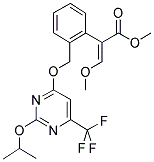
Fluacrypyrim is an acaricide. It has a low water solubility and is volatile. Little is known about its persistence in soil but it can be persistent in aquatic systems. It has a low level of toxicity to mammals. It shows a moderate to high level of toxicity to most aquatic species, earthworms and birds. It is not particularly toxic to honeybees.
Fluacrypyrim is used as a pesticide. A novel uterine relaxant with antinociceptive and anti-inflammatory properties.
ChEBI: Fluacrypyrim is a member of pyrimidines, an organofluorine acaricide, a methyl ester, an enoate ester and an enol ether. It has a role as a mitochondrial cytochrome-bc1 complex inhibitor.
The production of fluacrypyrim involves a multi-step organic synthesis built around constructing its pyrimidine-based acaricidal structure. The process begins with the preparation of (E)-2-(2'-chloromethyl)phenyl-3-methoxymethyl acrylate, which serves as a key intermediate. This compound is then reacted with 2-isopropoxy-4-hydroxy-6-trifluoromethylpyrimidine in the presence of potassium carbonate as a base and dimethylformamide as the solvent. The reaction mixture is heated to facilitate nucleophilic substitution, forming the desired fluacrypyrim molecule.
Mitochondrial complex III electron transport inhibitor - at Qo site.
Acaricide; Miticide; Insecticide