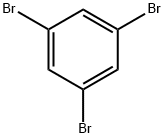
Lump powder; Vapour pressure of 1,3,5-tribromobenzene between 295 and 389 K (solid) and 397 and 410 K (liquid). The enthalpies of sublimation and vaporisation were derived from the relationship between vapour pressure and temperature: ΔH°SUB(334.78 K) = 83.54 ± 2 kJ/mol and ΔH°vap(403.23 K) = 58.68 ± 1.5 kJ/mol.
Intermediate in drug manufacturing; organic synthesis; internal standard in analysis of
aqueous samples.
1,3,5-Tribromobenzene, is a reagent that can be used in the preparation of different inhibitors. It is also a substituted Bromobenzene, a general reagent in palladium-catalyzed reactions and in the synthesis of Grignard reagents.
- 1,3,5-Tribromobenzene(TBB) acts as internal standard during derivatization step in determination of cyanide in human plasma and urine by gas chromatography-mass spectrometry.
- TBB forms molecular complexes of 1:2 stoichiometry with [60]-and [70] fullerenes.
- TBB reacts with perfluoroalkenylzinc reagent in the presence of Pd(Ph3)4 catalyst to yield a novel trifunctional monomer 1,3,5-tris(α, β, β-trifluorovinyl)benzene.
Pour 10 mol of benzene into a 500 ml three-necked bottle, add 200 ml of trichloromethane and 0.4 g of iron powder, stirring to dissolve, ice bath until the system is about 0 , protected from light, slowly add 35 mol of liquid bromine and 80 ml of trichloromethane mixture, the reaction is at room temperature for 10 hours, a large number of yellow-brown solid precipitation. At the end of the reaction, saturated aqueous sodium bisulfite was added to remove excess unreacted bromine. The crude product was washed twice with saturated aqueous sodium bisulfite solution, dried, and purified by recrystallization to obtain a light yellow-brown powder.
Photolytic. Peijnenburg et al. (1992) investigated the photodegradation of a variety of
substituted aromatic halides using a Rayonet RPR-208 photoreactor equipped with 8 RUL 3,000-
lamps (250–350 nm). The reaction of 1,3,5-tribromobenzene (initial concentration 10-5 M) was
conducted in distilled water and maintained at 20 °C. Though no products were identified, the
investigators reported photohydrolysis was the dominant transformation process. The measured
pseudo-first-order reaction rate constant and corresponding half-life were 0.005/min and 140.5
min., respectively.
Chemical/Physical. 1,3,5-Tribromobenzene will not hydrolyze to any reasonable extent.
Crystallise it from glacial acetic acid/water (4:1), then wash with chilled EtOH and dry in air. [Beilstein 5 H 213, 5 IV 685.]