These Secondary Standards are qualified as Certified Reference Materials. These are suitable for use in several analytical applications including but not limited to pharma release testing, pharma method development for qualitative and quantitative analyses, food and beverage quality control testing, and other calibration requirements.
Emulsifying agent (in soap form) for oils, fats,
and waxes; absorbent for acidic gases; organic syn-
thesis.
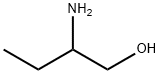
2-amino- 1-butanol is a precursor for the antituberculotic ethambuto.
Pharmaceutical secondary standards for application in quality control, provide pharma laboratories and manufacturers with a convenient and cost-effective alternative to the preparation of in-house working standards.
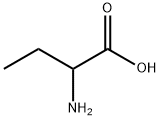
The general procedure for the synthesis of 2-amino-1-butanol and compounds (CAS:22621-37-0) from DL-2-aminobutyric acid is as follows:
Preparation of (+) - 2-amino-1-butanol (Example 9):
1. 1.8 g of L-2-aminobutyric acid obtained in Example 5 was dispersed in 30 mL of ethanol.
2. Dry hydrogen chloride gas was passed into this dispersed system until the L-2-aminobutyric acid was completely dissolved to form a homogeneous solution.
3. The resulting solution was refluxed for 4 hours.
4. Upon completion of the reaction, the reaction mixture was cooled and the ethanol was subsequently evaporated under reduced pressure.
5. The residue was dissolved in cooled ammonia and subsequently extracted with ether. 6.
6. The ether extracts were combined and dried with magnesium sulfate.
7. After drying, distillation was carried out under reduced pressure to collect the fraction with a boiling point of 66°C-67°C/18 mmHg to give 2.0 g of ethyl L-2-aminobutyrate in 90% yield. 8. The product had a specific optical rotation of 0.01%.
8. The specific optical rotation of the product was (α)D27 = +17.8°±1° (C=5.6, ethanol).
They are purified by shaking with solid NaOH, filtering and distilling through a short column. The oxalate of the racemate has m 176o. They are strong bases and should be stored under N2 in the absence of CO2. The enantiomers have [�] 20 ±12.5o (c 2, EtOH). [Johnson & Degering J Org Chem 8 7 1943, Nagao et al. J Org Chem 51 2392 1986, Santaniello et al. J Chem Soc, Perkin Trans 1 919 1985, Beilstein 4 H 291, 4 IV 1705.]
[1] Patent: US3979457, 1976, A