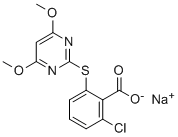
Pyrithiobac-sodium is a post-emergence herbicide for the control of broad-leaved weeds in cotton and other crops. It has a high aqueous solubility, is non-volatile and, based on its chemical properties, it is very mobile and has high potential to leach to groundwater. It is generally moderately persistent in soil systems but tends to be non-persistent in aquatic systems. It has a low mammalian toxicity but may bioaccumulate.
Pure product is white solid; Melting point: 233.8-234.2C (decomposition); Vapor pressure: 4.80 *10^-9 Pa; Partition coefficient: LogP(20C) = 0.6(pH 5), -0.84(pH 7). Solubility in water(20C,g/l):264(pH 5),705(pH 7),690(pH 9),728(distilled water);Solubility in other solvents(20C,mg/l):acetone 812,methanol 270000,dichloromethane 8.38,n-hexane 10.Stable for 32 days in aqueous solvents at pH 5-9,27°C,and for 15 days in storage under heat at 54°C. Stable in pH 5-9, aqueous solvent at 27°C for 32 days, heated at 54°C for 15 days.
Pyrithiobacsodium can be used as pesticides of interest in agricultural crop.
ChEBI: Pyrithiobac-sodium is an organic molecular entity.
Pyrithiobac-sodium is commercially synthesised through a multi-step process involving the condensation of chlorinated pyrimidine and phenylthioacetic acid derivatives. The production begins with the preparation of a chlorinated pyrimidinyl intermediate, which is reacted with a substituted phenylthioacetic acid in the presence of a base to form the core thioether linkage. This intermediate is then neutralised with sodium hydroxide to yield the sodium salt form, enhancing water solubility and formulation stability. The final compound is purified through crystallisation and dried under controlled conditions.
Pyrithiobac sodium acts on Acetolactate Synthase enzyme of the plant leaf and controls the growth of weeds and Quizalofop ethyl acts on acetyl-CoA carboxylase (ACCase) enzyme which stops the only grassy weed growth.