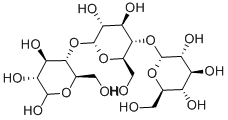
In nature, maltose is mainly found in germinated grains, especially malt, hence its name. Under the action of amylase, starch undergoes hydrolysis to produce maltodextrin, which further undergoes hydrolysis to produce two glucose molecules. Maltodextrin is a series of low-molecular-weight sugars obtained from starch hydrolysis; it is a group of linear α(1-4)-linked D-glucose polymers. Industrial-grade maltodextrin is typically produced by the acidic hydrolysis of potato starch. Maltotriose is composed of α(1-4)-linked D-glucose monomers with a degree of polymerization of 3.
displays potent and selective in vitro anti-human immunodeficiency virus type 1 activity. Prepared by modification of lysine e-amino groups
A trisaccharide resulting from the digestion of Amalose by α-Amalase.
Maltotriose is a matrose regulon inducer in Escherichia coli. Maltotriose has been used in a study to investigate the influence of fourth generation poly(propyleneimine) dendrimers on blood cells.
ChEBI: A maltotriose trisaccharide in which the glucose residue at the reducing end is in the aldehydo open-chain form.