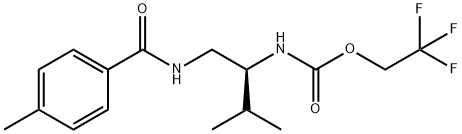
Tolprocarb is an oomyces fungicide, which has a strong inhibitory effect on rice blast fungus Magnaporthe grisea by inhibiting polyketide synthase in melanin synthesis pathway [1].
ChEBI: Tolprocarb is a carbamate ester that is the 2,2,2-trifluoroethyl ester of [(2S)-3-methyl-1-(4-methylbenzamido)butan-2-yl]carbamic acid. It is a novel systemic fungicide used for controlling rice blast. It has a role as an antifungal agrochemical. It is a member of benzamides, a carbamate ester, an organofluorine compound and a carbamate fungicide.
Commercial production of tolprocarb follows a six step synthetic route that begins with carbamate formation, where valine is coupled with trifluoroethyl chloroformate under basic biphasic conditions to generate the key carbamate intermediate. This intermediate is then treated sequentially with phosgene and ammonia to form a carboxamide, followed by a second phosgene mediated conversion to the corresponding nitrile. The nitrile undergoes palladium catalysed hydrogenation, producing an amine that is finally amidated with 4 methylbenzoic acid, yielding technical grade tolprocarb
Systemic, Polyketide Synthase Enzyme (PKS) Inhibitor, blocks melanin biosynthesis in the pathogen
[1] Hagiwara H, et al. Development of a novel fungicide, tolprocarb. J Pestic Sci. 2019 Aug 20;44(3):208-213. DOI:
10.1584/jpestics.J19-01