Flutianil is a horticultural fungicide. It has a very low solubility and is volatile. It is persistent in soils. It has a low mammalian toxicity but there are some concerns regarding effects on reproduction. It exhibits moderate to low toxicity to most aquatic and terrestrial organisms.
Odorless, white crystalline powder. Boiling point(2.53kPa)299.1℃. Vapor pressure(25℃)<1.3×10⁻²mPa.KowlgP=2.9.Relative density(30℃)1.45.Solubility in water 0.0079mg/L(20℃). Stabilized by heating to 280°C. No hydrolysis at 50℃, pH=4, 7, 9. Photodecomposition of aqueous solution DT503~4d.
Flutianil is a fungicide used in the treatment and protection of crops.
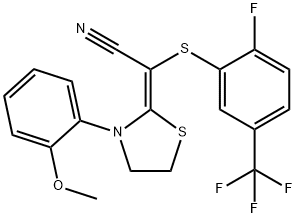
ChEBI: A member of the class of thiazolidines that is N-(o-methoxyphenyl)thiazolidine which is substituted at position 2 by a methylene group, the hydrogens of which are replaced by cyano and [2-fluoro-5-(trifluoromethyl)phenyl]sul
anediyl groups; the double bond conjugated to the cyano group has Z configuration. A fungicide intended for use on horticultural crops including strawberries and grapevines.
Flutianil is produced commercially through a multi-step synthesis centred on thiazolidine chemistry, where an o methoxyphenyl thiazolidine core is functionalised with cyano and fluorinated arylthio substituents. Industrial production begins with the preparation of the thiazolidine scaffold, followed by introduction of the 2 fluoro 5 trifluoromethylphenylthio group via selective sulfanyl substitution. The key intermediate is then condensed with acetonitrile derivatives to install the cyano functionality, ensuring the final (Z) configuration of the double bond. Careful control of reaction conditions is required to achieve the correct stereochemistry and high yield. The crude product undergoes purification steps such as solvent extraction and recrystallisation to reach technical-grade purity.
Contact action - both fungitoxic and fungistatic