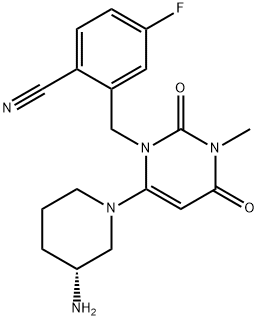
Using 2-bromo-5-fluorotoluene as a raw material, non-toxic potassium ferrocyanide was used as the cyanating agent, and palladium acetate was used as the catalyst to add the cyano group. Then, N-bromosuccinimide (NBS) was used as the brominating agent, and azobisisobutyronitrile (AIBN) was used as the catalytic free radical reaction. After substitution reaction, R-3-aminopiperidine was added, and then it formed a salt with TFA. Finally, it formed a salt with succinic acid in THF via salt-to-salt conversion to form trelagliptin succinate. Starting with 2-bromo-5-fluorotoluene (2) and dimethylformamide (DMF) as solvent, the mixture was heated to 165°C and coupled with cuprous cyanide to form a cyano group. The free radical reaction formed 2-bromomethyl-4-fluorobenzyl nitrile (4), which then underwent a substitution reaction with 3-methyl-6-chlorouracil to generate 2-(6-chloro-3-methyl-2,4-dioxo-3,4-dihydro-2H-pyrimidin-1-ylmethyl)-4-fluorobenzyl nitrile (5). This 5-fluorobenzyl nitrile then reacted with R-3-aminopiperidine dihydrochloride and trifluoroacetic acid (TFA) in ethanol to form the trifluoroacetate salt of the target product, trelagliptin.
Trelagliptin is a highly selective, long-acting dipeptidyl peptidase IV (DPP-4) inhibitor. This inhibitor provides sustained reduction of plasma DPP-4 activity and lowering of blood glucose in animal models of diabetes.
trelagliptin (syr-472) is a selective inhibitor of dpp-4 and is developed for the treatment of type 2 diabetes mellitus (t2dm) [1].dipeptidyl peptidase (dpp)-4 also known as adenosine deaminase complexing protein 2 or cd26 is an antigenic enzyme that expressed on the surface of most cell types and plays an important role in regulating immune system, signal transduction and apoptosis [2, 3].trelagliptin (syr-472) is a potent dpp-4 inhibitor and can be administered once weekly which unlike its other class approved agents that be taken once daily [1]. in japan,
[1]. mckeage, k., trelagliptin: first global approval. drugs, 2015. 75(10): p. 1161-4.
[2]. inagaki, n., et al., once-weekly trelagliptin versus daily alogliptin in japanese patients with type 2 diabetes: a randomised, double-blind, phase 3, non-inferiority study. lancet diabetes endocrinol, 2015. 3(3): p. 191-7.
[3]. inagaki, n., et al., syr-472, a novel once-weekly dipeptidyl peptidase-4 (dpp-4) inhibitor, in type 2 diabetes mellitus: a phase 2, randomised, double-blind, placebo-controlled trial. lancet diabetes endocrinol, 2014. 2(2): p. 125-32.