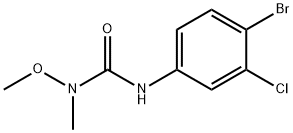
Chorbromuron is an obsolete herbicide. It has a moderate aqueous solubility, low volatility and, under normal conditions, would not be expected to leach to groundwater. Whilst not usually persistent in water bodies it can be persistent in soils. It is not highly toxic to humans if ingested but there is a data gap regarding other health issues. There is also a gap in available ecotoxicity data but based on data does exist it tends to be moderately toxic.
The certified reference material (CRM) is intended to be used as a calibrant for chromatography and other analytical techniques.
Chlorobromouron CRM can also be used as below:
- Method development for the quantification of 25 polar pesticides in fruit, vegetable, and water samples using high-performance liquid chromatography(HPLC)
- Separation and determination of 12 substituted phenylurea herbicides by HPLC in the study to assess the leaching of the herbicides in two agricultural soil samples
- Development of an HPLC method with diode array detection following dispersive liquid-liquid microextraction to determine 11 phenylurea herbicides in natural waters
- Investigation of 1,6-hexanediol ethoxylate diacrylate (HEDA)-based polymeric monoliths as a sorbent for the extraction of phenylurea herbicides from water samples
- Multi-residue analysis of 250 pesticides in surface water samples using liquid chromatography- quadrupole-Orbitrap high resolution tandem mass spectrometry
Chlorbromuron is produced commercially through a multi-step chemical synthesis involving the reaction of substituted anilines with isocyanates. The process typically begins with the preparation of 3-(4-bromophenyl)-1-chloro-1-methylurea by reacting 4-bromoaniline with methyl isocyanate, followed by chlorination. This reaction yields the active ingredient, which is then purified and formulated into a usable product.
ChEBI: Chlorbromuron is a member of ureas.
Photosynthetic electron transport inhibitor at the photosystem II. Sective, absorbed via roots and translocated
The main photoproducts initially formed in the
phototransformation of linuron and chlorbromuron in
aqueous solution result from photolysis, i.e.
hydroxylation with release of the halide ion, and from
elimination of a methoxy group. The orientation of the
reaction depends on the wavelength: short
wavelengths (254 nm) favor demethoxylation and
photolysis in the meta position,whereas, with black light longer than 330 nm,
photolysis in the para position is the main reaction
observed. In soils, 4-bromo-3-chloroaniline is identified
as a soil degradation product of chlorbromuron.