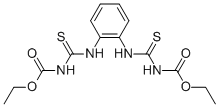
THIOPHANAT-ETHYL is a broad-spectrum systemic fungicide used to control powdery mildew, wheat scab, rapeseed sclerotinia, tomato leaf mold, and other diseases in various plants.
Commercial production of thiophanate is described mainly through industrial routes for thiophanate methyl, the principal commercial form. Manufacture begins with o phenylenediamine and sodium thiocyanate, which undergo a thiocyanation–condensation reaction to form the benzimidazole dithiocarbamate core. The process typically uses solvents such as ethyl acetate to dissolve reactants efficiently and shorten reaction time. After condensation, the mixture is neutralised, wastewater is treated or recycled, and the crude product is isolated by filtration or centrifugation
ChEBI: A member of the class of thioureas that is the diethyl ester of (1,2-phenylenedicarbamothioyl)biscarbamic acid. A fungicide effective against a broad spectrum of diseases in fruit, vegetables, turf and other crops including eyespot, scab, powdery mildew an
grey mould.
Colorless crystals. Non corrosive.
Hydrolyzed by alkaline media.
THIOPHANAT-ETHYL is a carbamate ester. Carbamates are chemically similar to, but more reactive than amides. Like amides they form polymers such as polyurethane resins. Carbamates are incompatible with strong acids and bases, and especially incompatible with strong reducing agents such as hydrides. Flammable gaseous hydrogen is produced by the combination of active metals or nitrides with carbamates. Strongly oxidizing acids, peroxides, and hydroperoxides are incompatible with carbamates. This substance is incompatible with copper containing compounds.
Inhibition of mitosis and cell division (Beta-tubulin assembly in mitosis)