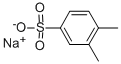
Sodium xylenesulfonate is obtained by sulfonating BTX fractions with sulfuric acid in a batch reactor, removing part of the residual organic phase, reacting the excess acid with fresh BTX, toluene or xylenes as desulfation agent, and neutralizing with NaOH; sulfonation of toluene plus xylenes reaches a conversion of 67.9%, with an SXS content above 45% at 130 °C and a positive effect from the xylene desulfation agent. The crude hydrotrope from selective sulfonation of a natural gas by-product initially contained over 8% sodium benzenesulfonate and over 15% residual sodium sulfate with toluene plus xylene conversion below 56%, and was later improved to 67.9% sulfonation[1]. Xylenesulfonic acids, the precursors of sodium xylenesulfonate, form when BTX mixtures recovered from the glycol unit of the Hannibal gas plant are sulfonated, and their amounts after neutralization are determined by ion exchange, reversed phase and ion-paired HPLC; the purified salt is obtained by drying in vacuum at 100 °C, dissolving in methanol, filtering off insoluble sodium sulfate, concentrating to saturation, precipitating with ether at −15 °C with heptane added, and reprecipitating from boiling water with acetone, giving white silky lamellar crystals[1-2].
[1]
Baati, R., Kamoun, A., Chaabouni, M., Sergent, M., Phan-Tan-Luu, R. (2006). Screening and optimization of the factors of a detergent admixture preparation. Chemometrics and Intelligent Laboratory Systems, 80(2), 198–208.
https://doi.org/10.1016/j.chemolab.2005.06.008 [2]
Horváth-Szabó, G., Yin, Q., Friberg, S. E. (2001). The Hydrotrope Action of Sodium Xylenesulfonate on the Solubility of Lecithin. Journal of Colloid and Interface Science, 236(1), 52–59.
https://doi.org/10.1006/jcis.2000.7391