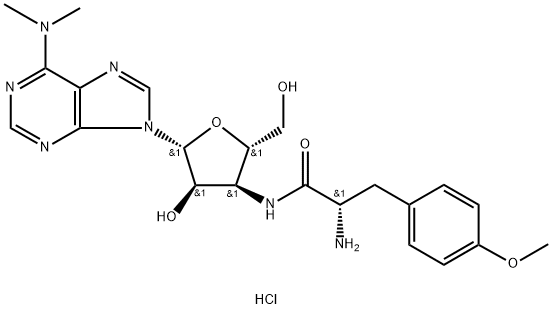
Puromycin (58-58-2) is an aminonucleoside antibiotic derived from Streptomyces alboniger. It is a protein synthesis inhibitor that disrupts peptide transfer on ribosomes causing premature chain termination.1 It is an inhibitor of dipeptidyl-peptidase II and cytosolic alanyl aminopeptidase.2 Puromycin also inhibits protein transport in mitochondria.3
Puromycin dihydrochloride is the salt of puromycin, a nucleoside antibiotic isolated from Streptomyces alboniger in the 1950s as an anti-trypansomal agent with antibiotic activity. While the salt shares the same pharmacological properties as puromycin free base, its greater water solubility offers advantages in some in vitro applications. Physicochemical properties and chromatographic behaviour will depend on whether the pH is buffered. In non-pH controlled systems, the free base and salt may behave differently.
Research tool for studying protein synthesis; cell line selection agent in gene transfer experiments.
Puromycin is an aminonucleoside antibitotic. Puromycin acts as a protein synthesis inhibitor which interferes with translation by inhibiting ribosome functions. Puromycin is also a reversible inhibitor of dipeptidyl-peptidase II (serine peptidase) and cytosol alanyl aminopeptidase.
An aminonuclease antibiotic used for selection and maintenance of cell lines expressing a transfected pac gene.
Puromycin dihydrochloride is a salt of puromycin, a nucleoside antibiotic isolated from Streptomyces alboniger in the 1950s as an anti-trypansomal agent with antibiotic activity. While the salt shares the same pharmacological properties as puromycin free base, its greater water solubility offers advantages in some in vitro applications. Physicochemical properties and chromatographic behaviour will depend on whether the pH is buffered. In non-pH controlled systems, the free base and salt may behave differently.
PUROMYCIN DIHYDROCHLORIDE is sensitive to prolonged exposure to heat. . Behaves as a very weak acid in solution.
Flash point data for PUROMYCIN DIHYDROCHLORIDE are not available, but PUROMYCIN DIHYDROCHLORIDE is probably combustible.
Puromycin dihydrochloride is purified by recrystallisation from H2O. The free base, [58-60-6] M 294.3, has m 175.5-177o (172-173o) (from H2O). The sulfate has m 180-187o dec (from H2O), and the picrate monohydrate has m 146-149o (from H2O). [Baker et al. J Am Chem Soc 77 1 1955, Fryth et al. J Am Chem Soc 80 3736 1958.] It is an inhibitor of aminopeptidase and terminates protein synthesis [Reboud et al. Biochemistry 20 5281 1981]. [Beilstein 26 III/IV 3704.]
Puromycin Dihydrochloride is hydrochloride salt that is part of the antibiotic puromycin, originally isolated from the bacterium Streptomyces alboniger. The clinical use of puromycin as an antibiotic has been limited as it is non-selective and highly toxic. Instead, puromycin has been used to study mechanisms of protein synthesis as it associates with growing polypeptide chains and causes premature chain termination. The structure of puromycin is analogous to the 3’ end of aminoacyl-tRNA, which allows puromycin to compete with aminoacyl-tRNA for binding at the A’ site of the peptidyl transferase center during protein translation. Puromycin binding results in premature chain release from the ribosome and a truncated, puromycylated polypeptide. As these puromycylated nascent polypeptide chains can be detected using anti-puromycin antibodies, incorporation of puromycin into newly synthesized proteins has been used to estimate the rate and localization of protein synthesis. The use of puromycin labeling to estimate protein synthesis may be limited by cell conditions; similar limits are seen in studies using puromycin to localize areas of protein synthesis.
[1] M E AZZAM I D A. Mechanism of puromycin action: fate of ribosomes after release of nascent protein chains from polysomes.[J]. Proceedings of the National Academy of Sciences of the United States of America, 1973, 70 12: 3866-3869. DOI:
10.1073/pnas.70.12.3866[2] N BHUTANI A L G P Venkatraman. Puromycin-sensitive aminopeptidase is the major peptidase responsible for digesting polyglutamine sequences released by proteasomes during protein degradation.[J]. The EMBO Journal, 2007: 1385-1396. DOI:
10.1038/sj.emboj.7601592[3] JEANNIE PRICE Keith V. Puromycin inhibits protein import into mitochondria by interfering with an intramitochondrial ATP-dependent reaction[J]. Biochimica et biophysica acta. Biomembranes, 1993, 1150 1: Pages 89-97. DOI:
10.1016/0005-2736(93)90125-j