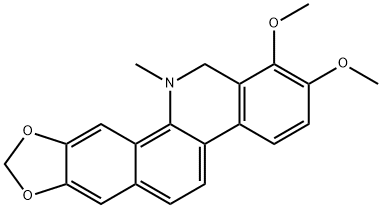
Dihydrochelerythrine is a benzophenanthridine alkaloid that has been found in Bocconia arborea and has diverse biological activities. It is active against S. aureus, S. faecalis, and C. albicans (MIC = 1.87 μg/ml for all). Dihydrochelerythrine inhibits secretion of the hepatitis B virus (HBV) antigens HBsAg and HBeAg from HepG2 2.2.15 cells (IC50s = <0.05 μM for both). It is cytotoxic to HCT8, BGC-823, and A2780 cancer cells (IC50s = 1.4, 0.4, and 3.5 μM, respectively).
Free dihydrochelerythrine crystals are insoluble in water, slightly soluble in methanol, and readily soluble in chloroform and dichloromethane. Dihydrochelerythrine is slowly and directly converted to chelerythrine in polar deuterium-substituting reagents (e.g., DMSO-d6 and MeOD), and in low-polarity deuterium-substituting reagents (e.g., CD2Cl2), it produces pseudo-bases and dimer intermediates, which are eventually oxidized to chelerythrine oxide.
Dihydrochelerythrine is synthesized as a potential G-quadrulpex DNA stabilizing agent. It is used in phamacokinetic study of chelerythrine metabolites in agro-products.
ChEBI: Dihydrochelerythrine is a benzophenanthridine alkaloid.
[1] VICTOR NAVARRO Guillermo D. Two antimicrobial alkaloids from Bocconia arborea[J]. Journal of ethnopharmacology, 1999, 66 2: Pages 223-226. DOI:
10.1016/s0378-8741(98)00182-2[2] YING-RUI WU. Two new quaternary alkaloids and anti-hepatitis B virus active constituents from Corydalis saxicola.[J]. Planta medica, 2007, 73 8: 787-791. DOI:
10.1055/s-2007-981549[3] AN-JUN DENG Hai lin Q. Cytotoxic dihydrobenzophenanthridine alkaloids from the roots of Macleaya microcarpa[J]. Phytochemistry, 2010, 71 7: Pages 816-822. DOI:
10.1016/j.phytochem.2010.02.007