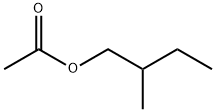
2-Methylbutyl acetate has an apple peel and banana odor.
All isomers of amyl acetate are highly flammable,
colorless to yellow, watery liquids.
2-Methylbutyl acetate has an apple peel and banana odor.
Reported found in apple, apple juice, pear, Scotch whiskey, white wine, Bantu beer, beer, cider, cocoa, fig,
grape, melon, pineapple, plum, baked potato, rum, sherry, strawberry, wine, apricot, vinegar, sweet cherry, pimento berry, olive, rye
bread, cognac, malt whiskey, rum, nectarines, mountain papaya and mango.
2-Methylbutyl acetate is a major contributor to the flavors of many apple cultivars, exhibiting banana and apple aroma attributes with a flavor threshold of 5 ppb in water[1][2]. Repeated exposure to 2-methylbutyl acetate may cause skin dryness or cracking[3].
ChEBI: The acetate ester of 2-methylbutan-1-ol.
Taste characteristics at 20 ppm: fruity, sweet, banana, juicy fruit and tutti-frutti note.
(n-isomer): Primary irritant (w/o allergic
reaction), (sec-isomer) Human Data. Amyl acetates are
used as industrial solvents and in the manufacturing and
dry-cleaning industry; making artificial fruit-flavoring
agents; cements, coated papers, lacquers; in medications
as an inflammatory agent; pet repellents, insecticides and
miticide. Many other uses.
UN1993 Flammable liquids, n.o.s., Hazard
Class: 3; Labels: 3-Flammable liquid, Technical Name
Required.
Vapors may form explosive mixture with
air. Incompatible with oxidizers (chlorates, nitrates, peroxides,
permanganates, perchlorates, chlorine, bromine, fluorine,
etc.); contact may cause fires or explosions. Keep
away from alkaline materials, strong bases, strong acids,
oxoacids, epoxides, nitrates. May soften certain plastics.
The current Initial Threshold Screening Level (ITSL) for 2-methyl butyl acetate is 1100 μg/m3.
Dissolve or mix the material
with a combustible solvent and burn in a chemical incinerator
equipped with an afterburner and scrubber. All federal,
state, and local environmental regulations must be observed.
In accordance with 40CFR165, follow recommendations for
the disposal of pesticides and pesticide containers. Must be
disposed properly by following package label directions or
by contacting your local or federal environmental control
agency, or by contacting your regional EPA office.
[1]Rowan, D. D., Lane, H. P., Allen, J. M., Fielder, S., & Hunt, M. B. (1996). Biosynthesis of 2-Methylbutyl, 2-Methyl-2-butenyl, and 2-Methylbutanoate Esters in Red Delicious and Granny Smith Apples Using Deuterium-Labeled Substrates. Journal of Agricultural and Food Chemistry, 44(10), 3276–3285.
https://doi.org/10.1021/jf9508209 [2]Matich, A., & Rowan, D. (2007). Pathway Analysis of Branched-Chain Ester Biosynthesis in Apple Using Deuterium Labeling and Enantioselective Gas Chromatography−Mass Spectrometry. Journal of Agricultural and Food Chemistry, 55(7), 2727–2735.
https://doi.org/10.1021/jf063018n [3]on Additives and Products or Substances used in Animal Feed (FEEDAP), E. P. (2012). Scientific Opinion on the safety and efficacy of branched‐chain primary aliphatic alcohols/aldehydes/acids, acetals and esters with esters containing branched‐chain alcohols and acetals containing branched‐chain aldehydes (chemical group 2) when used as flavourings for all animal species. EFSA Journal, 10(10).
https://doi.org/10.2903/j.efsa.2012.2927