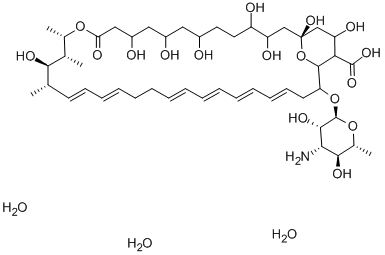
Light yellow powder. There are three kinds of bioactive components, A1, A2 and A3, with strong reducibility. Suspension at pH 7.0, can be stabilized at 100 ℃ for 10min, light, heat, oxygen accelerated decomposition; no melting point, heated to more than 160 ℃ decomposition; specific optical rotation [α] 25D +21 ° (pyridine), +12 ° (dimethylformamide), -7 ° (0.1 mol / L hydrochloric acid in methanol solution) and -10 ° (glacial acetic acid); the maximum absorption wavelengths in ethanol are 290nm, 307nm and 322nm. 290nm, 307nm and 322nm.Solubility at room temperature: water 4mg/ml, methanol 11.2mg/ml, ethanol 1.2mg/ml, ethylene glycol 8.75mg/m|, carbon tetrachloride 1.23mg/ml, chloroform 0.48mg/ml, benzene 0.28mg/ml.LD50 (mouse, intraperitoneal) about 200mg/kg.
ChEBI: Nystatin A1 is a polyene macrolide antibiotic; part of the nystatin complex produced by several Streptomyces species. It is an antifungal antibiotic used for the treatment of topical fungal infections caused by a broad spectrum of fungal pathogens comprising yeast-like and filamentous species.