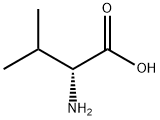
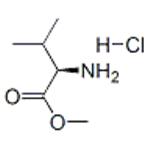
D-Valine methyl ester hydrochloride is a protected form of D-Valine (V094200). D-Valine (an isomer of the essential amino acid L-Valine [V094205])exhibited inhibitory effects on fibroblasts that contaminated mammalian kidney cultures, allowing for selective growth epithelial cells. D-Valine is also known for its presence in the structure of Actinomycin D, an antitumour drug. D-Valine is naturally synthesized by Streptomyces antibioticus.
The general procedure for the synthesis of D-valine methyl ester hydrochloride from methanol and D-valine was as follows: 8-10 mL of thionyl chloride was added slowly and dropwise to 100 mL of dry methanol suspension containing 5 g of D-valine at 0-5 °C. The reaction mixture continued to be stirred for 2 hours after the dropwise addition was completed, and was subsequently kept at 20-22°C for 24 hours to complete the reaction. After completion of the reaction, the solvent was removed by vacuum evaporation at 30-40°C. The residue was mixed with anhydrous ether and the product was separated by filtration, dried and recrystallized from the mixed methanol-ether solvent to give D-valine methyl ester hydrochloride. The yield of this synthesis step was 75% and the product had a melting point of 155-156°C and a specific spin of -15±1° (c=1.0, EtOH). Literature reports a specific spin of -15.5±2° (c=2.0,2). Infrared spectra (cm-1) showed characteristic absorption peaks located at 1730 and 1575.
[1] Tetrahedron, 1989, vol. 45, # 17, p. 5641 - 5654
[2] Journal of Labelled Compounds and Radiopharmaceuticals, 2002, vol. 45, # 6, p. 449 - 470
[3] European Journal of Organic Chemistry, 2010, # 22, p. 4276 - 4287
[4] Journal of the American Chemical Society, 2013, vol. 135, # 19, p. 7235 - 7250
[5] Russian Journal of Bioorganic Chemistry, 2017, vol. 43, # 4, p. 456 - 462