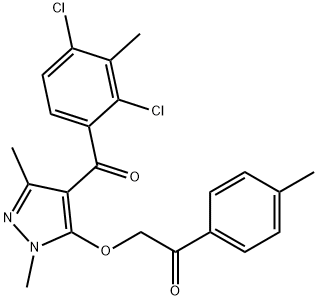
Benzofenap is a herbicide used mainly to control broadleaved weeds in water-seeded rice. It has a low aqueous solubility, is not volatile and is moderately persistent in soil systems with a low risk of leaching to groundwater. Benzofenap tends to have a low to moderate toxicity to biodiversity. Its toxicity to mammals including humans is low if ingested. It is also a skin irritant.
Benzofenap is a 4-benzoylpyrazole molecule used for
the selective control of annual and some perennial
broadleaf weeds (especially Sagitaria spp.) in rice in
Japan (as Yukawide) (31) and other countries such as
Australia (as Taipan) (32). Mixtures with bromobutide,
pretilachlor, pyributicarb, ormonilate are used to complete
its spectrum.
ChEBI: Benzofenap is a member of acetophenones. It has a role as a carotenoid biosynthesis inhibitor.
Benzofenap is commercially produced via a process that starts with the construction of the 3-(4-chloro-2-fluoro-5-hydroxyphenyl)-1-methyl-5-(trifluoromethyl)pyrazole core through condensation of 4-chloro-2-fluoro-5-methoxyphenylhydrazine with ethyl 4,4,4-trifluoroacetoacetate under acidic conditions, followed by cyclisation and demethylation with boron tribromide in dichloromethane. The key ether linkage is formed via nucleophilic substitution with 2-chlorobenzoxazole using potassium carbonate
Systemic, absorbed through roots. Bleaching inhibition of 4-hydroxyphenyl-pyruvate-dioxygenase.