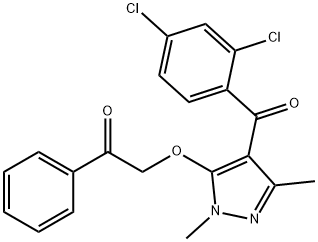
ChEBI: Pyrazoxyfen is a member of the class of pyrazoles that is 1,3-dimethylpyrazole which is substituted at positions 4 and 5 by 2,4-dichlorobenzoyl and 2-oxo-2-phenylethoxy groups, respectively. A pro-herbicide (for the corresponding 5-hydroxypyrazole), it is used as a pre- or post-emergence herbicide for the control of annual and perennial weeds in rice. It has a role as a proherbicide, an agrochemical and a carotenoid biosynthesis inhibitor. It is a member of acetophenones, a member of pyrazoles and a dichlorobenzene.
Pyrazoxyfen is commercially produced via a two-step etherification process starting from 2,6-dichloro-4-nitrophenol, which is selectively alkylated at the phenolic oxygen with 2-(2-propynyloxy)ethyl bromide using potassium carbonate in DMF to form the propargyl ether intermediate. This is followed by reduction of the nitro group using iron powder in acetic acid or catalytic hydrogenation (Pd/C) to yield 4-amino-2,6-dichloro-1-(2-propynyloxyethoxy)benzene, which undergoes condensation with pyrazole-4-carbaldehyde in ethanol under acidic catalysis (e.g., p-toluenesulfonic acid) at reflux to construct the imine linkage, affording pyrazoxyfen.
Selective, systemic absorbed through young stems and roots. Bleaching: inhibition of 4-hydroxyphenyl-pyruvate-dioxygenase.