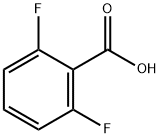
The synthesis process of 2,6-difluorobenzoic acid (DFBA) involves using 2,6-dichlorobenzonitrile (DCBN) and potassium fluoride as raw materials, and N,N-dimethylamide (DMF) as solvent. The intermediate 2,6-difluorobenzonitrile is synthesized by fluorination under the catalysis of polyether catalyst A. The intermediate is then hydrolyzed under alkaline conditions to obtain 2,6-difluorobenzoic acid. Experimental results show that the optimal reaction conditions are: a mass concentration of 2,6-dichlorobenzonitrile in N,N-dimethylamide of 0-38 g/mL, a potassium fluoride concentration 2.3-2.4 times that of 2,6-dichlorobenzonitrile, a reaction time of 10 h, and a maximum yield of 93.5%. In the synthesis of 2,6-difluorobenzoic acid, using 20% NaOH as the medium and a reaction time of 9 h, the yield is ≥92%. This process offers high yield, low waste emissions, and cost savings, making it a promising candidate for industrial application.
2,6-Difluorobenzoic acid has been used in the synthesis of 2,6-difluoro-N-(3-methoxy-1H-pyrazolo[3,4-b]pyridine-5-yl)-3-(propylsulfonamidio)benzamide and methyl 2,6-difluorobenzoate.