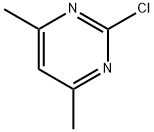
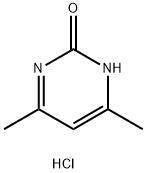
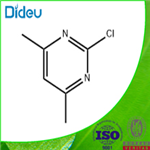
General procedure for the synthesis of 2-chloro-4,6-dimethylpyrimidine from 4,6-dimethyl-2-hydroxypyrimidine hydrochloride: 4,6-dimethyl-2-hydroxypyrimidine hydrochloride (1998 mg, 12.44 mmol) was mixed with phosphorochloridic acid (20 mL) and the reaction was carried out at reflux for 10 hours. Upon completion of the reaction, excess phosphorus trichloride was removed by distillation under reduced pressure to give a brown oil. The reaction mixture was cooled in an ice bath and concentrated aqueous potassium hydroxide solution was added slowly and dropwise to a pH of about 8 (detected by litmus paper). Diethyl ether (30 mL) was then added and stirring was continued for 2.5 hours. The aqueous layer was separated and extracted with ether (3 x 30 mL) and ethyl acetate (3 x 30 mL), respectively. The organic phases were combined, washed with saturated brine, dried over anhydrous sodium sulfate, filtered and concentrated under reduced pressure. The resulting yellow liquid was placed in an ice bath and dried under vacuum to give 2-chloro-4,6-dimethylpyrimidine (1606 mg, 91% yield) as yellow crystals.1H NMR (400 MHz, DMSO-d6) δ 7.33 (s, 1H), 2.42 (s, 6H).
[1] PLoS ONE, 2018, vol. 13, # 1,
[2] Journal of Organic Chemistry, 2002, vol. 67, # 18, p. 6550 - 6552
[3] Phosphorus, Sulfur and Silicon and the Related Elements, 2008, vol. 183, # 4, p. 986 - 991
[4] Journal of Organometallic Chemistry, 2013, vol. 732, p. 137 - 141