White crystalline powder, soluble in methanol, ethanol, DMSO and other organic solvents.
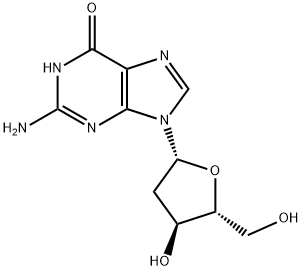
2'-Deoxyguanosine (Deoxyguanosine; dG) is composed of the purine nucleoside guanine linked by its N9 nitrogen to the C1 carbon of deoxyribose. It is a purine nucleoside that upon sequential phosphoylation (kinases) forms dGTP which is used by DNA polymerases and reverse transcriptases to synthesis DNA(s). Deoxyguanosine is the most electron rich of the four canonical bases and includes many nucleophilic sites which are susceptible to oxidative damage. This makes deoxyguanosine and its oxidized derivatives useful reagents to study mechanisms of oxidative damage to nucleosides and nucleotides.
ChEBI: 2'-deoxyguanosine is a purine 2'-deoxyribonucleoside having guanine as the nucleobase. It has a role as a Saccharomyces cerevisiae metabolite, a human metabolite, an Escherichia coli metabolite and a mouse metabolite. It is a purines 2'-deoxy-D-ribonucleoside and a purine 2'-deoxyribonucleoside. It is functionally related to a guanosine.
8-Hydroxy-2'-deoxyguanosine (8-OHdG) is the most commonly used marker of DNA oxidation for the diagnosis of oxidative DNA damage and bipolar disorder (BD), as well as for the prevention of plaque formation and for the inhibition of vascular smooth muscle cell activation through Rac1 inactivation.
2‘-Deoxyguanosine (2’dGuo) is a purine nucleoside metabolite that has been shown to inhibit proliferation-dependent antigen-specific suppressor T cell (Ts) function in mouse and human systems. 2'dGuo also inhibits mitogen-induced T cell proliferation. Low concentrations (40 gM) of 2'dGuo enhanced phytohemagglutinin- and amantadine A-induced T-cell transformation, possibly due to the inhibition of T-cell function leading to the promotion of T-cell growth factor production. T-cell responses were inhibited only when the concentration of 2'dGuo was toxic to lymphocytes.[1]
Human Endogenous Metabolite
2'-Deoxyguanosine recrystallises from H2O as the monohydrate. [Brown &C5440 Lythgoe J Chem Soc 1990 1950, L
[1] A C HANGLOW; P M L. The effect of 2’deoxyguanosine on human lymphocyte responses. I. 2’deoxyguanosine enhances T lymphocyte responses.[J]. Clinical and experimental immunology, 1985, 59 3: 653-658.