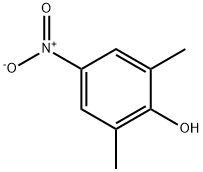
orange crystalline powder
2,6-Dimethyl-4-nitrophenol was used to study the disposition requirement for binding of p-nitrophenol and sodium p-nitrophenolate like substrates with cyclohexaamylaose. It was used as internal standard in determination of 4-nitrophenol and 3-methyl-4-nitrophenol in human urine by liquid chromatography combined with tandem mass spectrometry .
2,6-Dimethyl-4-nitrophenol is a useful compound for the production and characterization of bio-oil from hardwood and softwood lignin.
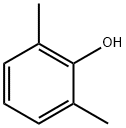
General method: A solid mixture of 2,6-dimethylphenol (1-3 eq.) and Bi(NO3)3-3H2O (1 eq.) or Fe(NO3)3-9H2O (1 eq.) was mixed with acetone (10 mL/mmol). The reaction mixture was stirred in air at room temperature or under reflux conditions for 2-24 hours (see Tables 1 and 2). Upon completion of the reaction, the insoluble material was removed by filtration through a diatomaceous earth pad and the residue was washed with acetone (~5 mL/mmol). The filtrate was treated with NaHCO3 (0.1 g/mmol) until CO2 release ceased. The insoluble material was removed by filtration again, followed by concentration under reduced pressure in a water bath at 25-35°C to remove the solvent. The nitration products were separated or purified by silica gel column chromatography to give pure phenolic compounds. All products were characterized by 1H NMR, 13C NMR and IR and identified by comparison with spectral data and melting points reported in the literature.
[1] Synthetic Communications, 2015, vol. 45, # 1, p. 143 - 150