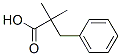
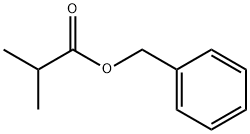
The general procedure for the synthesis of 2,2-dimethyl-3-phenylpropionic acid from benzyl isobutyrate was as follows: hexamethyldisilazane (34 g, 0.21 mol) was dissolved in tetrahydrofuran (280 mL) at -78 °C, and a hexane solution of 1.67 M n-butyllithium (127 mL, 0.21 mol) was slowly added dropwise. The reaction solution was warmed to 0 °C within 1 h and subsequently cooled again to -78 °C. A solution of tetrahydrofuran (70 mL) of benzyl isobutyrate (25 g, 0.14 mol) was added dropwise and kept stirring at -78 °C for 1 hour. At the same temperature, chlorotrimethylsilane (36 mL, 0.12 mol) was continued to be added dropwise with stirring for 1 h. The reaction was warmed up to room temperature and stirred continuously for 19 h. The reaction was completed by adding a solution of benzyl isobutyrate (25 g, 0.14 mol) in tetrahydrofuran (70 mL). Upon completion of the reaction, some of the solvent was concentrated under reduced pressure and the resulting white suspension was diluted with hexane (200 mL) and the white solid was removed by filtration through diatomaceous earth under nitrogen protection. The filtrate was distilled under reduced pressure to yield a light yellow oil, which was converted to a brown oil by heating at 100 °C for 2 hours. The oily substance was mixed with 10 mL of 1 M hydrochloric acid, stirred at 60 °C for 4 h. After neutralization with saturated aqueous sodium bicarbonate solution, it was extracted with ethyl acetate (100 mL x 2) and chloroform (100 mL x 2), respectively. The organic layers were combined, concentrated and purified by medium-pressure silica gel column chromatography (80 g of silica gel, 100% ethyl acetate) to afford 8.41 g of the target product, 2,2-dimethyl-3-phenylpropionic acid, as white crystals.1H NMR (CDCl3, Me4Si, 300 MHz) δ 7.20-7.30 (m, 3H), 7.16 (d, J = 7.1 Hz, 2H). 2.89 (s, 2H), 1.21 (s, 6H).