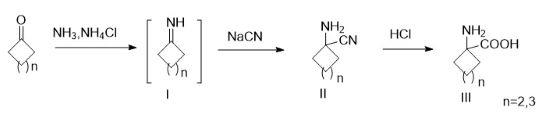
In a 250 mL round-bottom flask, add cyclohexanone (14.8 g, 150 mmol), NH4Cl (8.3 g, 165 mmol), ammonia (20 mL, 270 mmol), anhydrous ethanol (45 mL), and water (30 mL). Stir at room temperature until the solution becomes clear. Continue stirring for 3 hours until the solution turns pale red. Add NaCN (8.1 g, 165 mmol) and seal the flask. Stir the reaction mixture at room temperature for 1 day. The reaction solution changes from pale red to reddish-brown, and a large amount of white solid is formed.
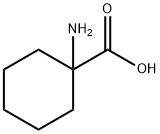
Most of the ethanol and ammonia were removed by vacuum distillation. After cooling to room temperature, the mixture was extracted with dichloromethane (3 × 30 mL), and the organic layers were combined. The mixture was washed with 2 × 10 mL of water and dried over anhydrous sodium sulfate. The mixture was filtered, and the dichloromethane was recovered to give 18.0 g of crude reddish-brown 1-aminocyclohexane nitrile, with a yield of 96.8%. This was used directly in the next reaction. Under ice bath conditions, pre-cooled concentrated hydrochloric acid (75 mL) was added to the 1-aminocyclohexyl nitrile obtained above, releasing a large amount of heat. The mixture was stirred overnight at room temperature, and the solid dissolved. After reflux for 3 h, a large amount of solid was formed. The solid was distilled to dryness under vacuum, and 30 mL of water was added. The mixture was evaporated to dryness to give a yellow residue. 15 mL of water was added, and the pH was adjusted to 3–4 with 4 mol/L NaOH solution in an ice bath. The mixture was stirred overnight at room temperature, filtered, and washed with anhydrous ethanol to give a white solid. Recrystallization from a 75% aqueous ethanol solution gave 12.5 g of white crystals of the target compound, with a yield of 58.3%.