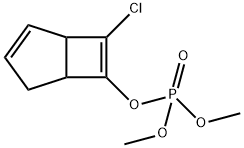
Heptenophos is a light brown liquid or crystalline mass. It is soluble
in water (2.2 g/L at 20 C) and miscible with most organic
solvents, except aliphatic hydrocarbons. Log Kow = 2.32.
Heptenophos is hydrolyzed in acidic and alkaline media.
Pale amber liquid; miscible in most organic solvents; soluble in xylene, acetone, and methanol.
Heptenophos is a pesticide used for fruits and vegetables.
Heptenophos is used to control sucking pests (primarily aphids) in
a wide range of crops. It is also used as an ectoparasiticide to control ticks,
lice, mites and fleas in farm animals and pets.
A nonpersistent contact and systematic phosphate insecticide.
Heptenophos is produced through a multi-step chemical process involving esterification and dehydration. The synthesis begins with the preparation of a wet crude product, which is mixed with an organic solvent and subjected to distillation and dehydration to isolate heptenophos. This is followed by spray heating or membrane evaporator heating, using the solvent as a carrier to enable continuous dehydration, blending, and packaging. In a final step, complexation with maneb and zinc is performed in the same solvent system, which facilitates crystal transformation while minimizing product decomposition and reducing impurities and dust pollution.
Poison; moderately toxic.
Systemic with stomach, contact and respiratory action. Acetylcholinesterase (AchE) inhibitor.
Metabolism of heptenophos in soils is by hydrolysis to 7-chloro-bicyclo[3.2.0]hept-2-en-6-one, further transformations of which involve
microbially-mediated Baeyer-Villiger oxidations of the cyclobutanone
moiety, ring opening of the resultant lactones, dechlorination and
dehydrochlorination followed by ultimate mineralisation to CO2 and conversion to unextractable soil-bound residues. In rats, 7-chlorobicyclo[3.2.0]hept-2-en-6-one is further transformed to give the Favorskiirearranged product bicyclo[3.l.0]hex-2-en-6-exo-carboxylic acid as a
urinary metabolite.
In rats 90% of heptenophos is
excreted in the urine and 6% in the feces as water-soluble
metabolites within 6 days after oral administration. In
plant (lettuce), it is completely transformed to watersoluble
metabolites without accumulation within 4 d. In
soil, it is rapidly degraded bymicroorganisms, DT50 (20 C)
being less than 4 h.
Acute oral LD50 for rats is
96–121 mg/kg. Inhalation LC50 (4 h) for rats is 0.95 mg/L
air. NOEL (2 yr) for rats is 15 mg/kg diet (0.75 mg/kg/d).
ADI is 3 μg/kg b.w.
Heptenophos is hydrolysed in acidic and alkaline media (PM).
Insecticide; Acaricide; Veterinary substance