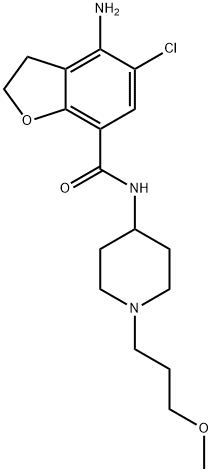
Prucalopride is a potent and selective agonist of the serotonin (5-HT) receptor subtype 5-HT4 (Kis = 2.5 and 8 nM for human 5-HT4A and 5-HT4B, respectively). Prucalopride is greater than 250-fold selective for 5-HT4 over a panel of 53 overexpressed receptors, including 5-HT subtypes, but does bind to human dopamine D4 and sigma-1 (σ1) receptors and mouse 5-HT3 receptors (Kis = 2.3, 3.7, and 3.8 μM, respectively). It induces contractions in guinea pig colon with an EC50 value of 33 nM, an effect that is blocked by the 5-HT4 antagonist GR113808 but not the 5-HT2A and 5-HT3 antagonists ketanserin and granisetron , respectively. It also facilitates non-cholinergic contractions induced by electrical stimulation. In fasted dogs, oral administration of prucalopride increases colonic motility by inhibiting distal colon contractions (ED50 = 0.04 mg/kg), an effect that is blocked by pretreatment with the 5-HT4 antagonist GR125487. Prucalopride (5-10 mg/kg, s.c.) increases acetylcholine and histamine levels in the rat prefrontal cortex by 2.4-fold and 3-fold, respectively, and increases the power of hippocampal theta oscillations. Formulations containing prucalopride have been used in the treatment of chronic idiopathic constipation.
Prucalopride is a highly selective serotonin 5-HT4 receptor agonist and dihydrobenzofurancarboxamide derivative with gastrointestinal prokinetic activity. It is indicated for the treatment of laxative-resistant chronic idiopathic constipation and is available as oral tablets in strengths of 0.5, 1, 2, and 4 mg[2][3][4]. In patients with chronic idiopathic constipation, prucalopride improves colonic motility by stimulating high-amplitude propagating contractions, thereby decreasing colonic transit time and increasing the frequency of complete spontaneous bowel movements. Clinical trials have demonstrated that daily doses of 2 mg or 4 mg significantly accelerate gastric emptying, small bowel transit, and whole-gut transit compared with placebo, with 2 mg once daily showing comparable efficacy to 4 mg once daily[3][4][5]. Prucalopride has been shown to improve gastric emptying half-time in patients with idiopathic gastroparesis and restore normal bowel function in subgroups of difficult-to-treat patients. The drug does not interact with hERG potassium channels or 5-HT1B receptors, and administration at doses up to 10 mg daily has not resulted in QTcF prolongation. Common adverse events include nausea, vomiting, diarrhea, and headache, which are reported more frequently than with placebo but are typically mild to moderate[2][3][5].
ChEBI: Prucalopride is a member of benzamides.
In healthy male individuals, prucalopride decreases the display of esophageal acid and promotes gastric emptying. It is effective, safe and shows good tolerance for the treatment of men with chronic constipation.
Prucalopride is a high affinity, highly selective 5-HT4 agonist. Its action in the treatment of chronic constipation is to stimulate intestinal peristalsis by specifically interacting with 5-HT4 receptors in the digestive tract, resulting in the release of acetylcholine, which further constricts the muscular layer of the colon, and the relaxation of the circular muscular layer promoting the expulsion of luminal contents.
Prucalopride is usually well tolerated. The most common adverse reactions include: headache, nausea, abdominal pain and diarrhoea. Other adverse reactions that may occur include: abnormal stomach or bowel sounds, flatulence, decreased appetite, dizziness, unusual tiredness or weakness, pain in the extremities or chest, difficulty or inability to speak, difficulty breathing, and suicidal thoughts. Severe allergic reactions are rare and usually manifest as hives or lumps, itching, rash, redness of the skin, swelling of the face, and tightness in the chest.
This novel enterokinetic drug (FW = 367.87 g/mol; CAS 179474-81-8), also known by the tradename Resolor and its systematic name, 4-amino-5- chloro-N-[1-(3-methoxypropyl)piperidin-4-yl]-2,3-dihydro-1-benzofuran-7- carboxamide, is a selective, high affinity serotonin 5-HT4 receptor agonist with that stimulates colonic mass movements, which provide the main propulsive force for defecation. It exhibits high affinity to both 5-HT4 receptor isoforms, with respective pKi values of 8.60 and 8.10 for the human 5-HT4A and 5-HT4B receptors. Based on 50 other binding assays,tonly the human D4 receptor (pKi = 5.63), the mouse 5-HT3 receptor (pKi = 5.41) and the human s1 (pKi = 5.43) shown measurable affinity, resulting in >290x selectivity for 5-HT4 receptors. Prucalopride also differs from other 5-HT4 agonists, such as tegaserod and cisapride, that interact with other receptors (5-HT1B/D and cardiac human ether-a-go-go K+ or hERG channel, respectively).
[1] Patent: CN106146386, 2016, A. Location in patent: Paragraph 0068; 0069; 0070; 0071
[2]
Vijayvargiya, P., Camilleri, M. (2019). Use of prucalopride in adults with chronic idiopathic constipation. Expert Review of Clinical Pharmacology, 12(7), 579–589.
https://doi.org/10.1080/17512433.2019.1620104[3]
Coremans, G. (2008). Prucalopride: the evidence for its use in the treatment of chronic constipation. Core Evidence, 0.
https://doi.org/10.2147/ce.s7441 [4]
Keating, G. M. (2013). Prucalopride: A Review of Its Use in the Management of Chronic Constipation. Drugs, 73(17), 1935–1950.
https://doi.org/10.1007/s40265-013-0140-1 [5]
Quigley, E. M. M. (2011). Prucalopride: safety, efficacy and potential applications. Therapeutic Advances in Gastroenterology, 5(1), 23–30.
https://doi.org/10.1177/1756283x11423706