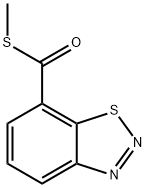
Acibenzolar-S-methyl (Novartis) has attracted special
attention because it acts against a very wide range of
plant diseases but does not directly affect the growth
or metabolism of the causal organisms. It is known to
act by stimulating systemic activated resistance (SAR)
in the treated plant. The well-established compound
probenazole, which for some years has been the leading
treatment for rice blast in Japan, is thought to act in a
similar way. Pathogen resistance to probenazole has not
developed, and such stability of performance may well be
a general feature of SAR-inducing compounds.
Pure product is white to beige powdery solid, and has the odor of burning. m.p. 132.9 ℃, b.p. about 267 ℃, the relative density of 1.54 (20 ℃), the vapor pressure of 4.4 × 10⁻⁴Pa (25 ℃). 25 ℃ at the solubility: methanol 4.2g / L, ethyl acetate 25g / L, hexane 1.3g / L, toluene 36g / L, acetone 28g / L, n-octyl alcohol 5.4g / L, dichloromethane 160g / L, water 7.7g / L. Distribution coefficient 3.1 (20 ℃). Octanol 5.4g/L, dichloromethane 160g/L, water 7.7g/L. Partition coefficient 3.1 (20℃). Hydrolysis half-life 3.8 years (20℃, pH=5), 23 weeks (20℃, pH=7), 19.4h (20℃, pH=9).
Acibenzolar-S-methyl is a S-methyl thioester derivative of acibenzolar. Acibenzolar-S-Methyl acts as a fungicide in pesticidal formulations.
Plant disease resistance activator.
CGA245704 is used to control a range of diseases in wheat and
it is being developed for use on rice, bananas, vegetables and tobacco.
Acibenzolar-S-methyl is manufactured through a multi-step chemical synthesis that begins with the formation of the 1,2,3-benzothiadiazole core. This heterocyclic ring is created via a classic ring-closure reaction, where a thiol group reacts with an adjacent diazonium group on a benzene ring. The resulting compound, 1,2,3-benzothiadiazole-7-carboxylic acid, is then converted into its S-methyl thioester form through standard chemical transformations, typically involving hydrolysis to the free acid followed by reaction with thionyl chloride to form the acid chloride, and finally methylation with a thiol reagent.
ChEBI: A benzothiadiazole that is the S-methyl thioester derivative of acibenzolar. It is used as a fungicide and plant activator on a variety of crops, including cotton, chili peppers, lettuce, onions, spinach, tobacco, and tomatoes.
Systemic Activated Resistance (SAR). Induces host plant defence.
Very little information on the fate of CGA245704 has been published. It
is readily degraded in soil and plants and it is rapidly eliminated from
animals. A partial metabolic pathway is shown in Scheme 1.
CGA245704 is a stable substance and it is very stable in solution other
than at high pH values. Its DT50 values (20 °C) at pH 5, 7 and 9 were 3.8
years, 23 weeks and 19 hours, respectively (PM). Hydrolysis of the
thioester link and ring opening would be anticipated.