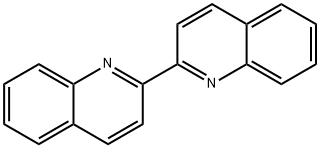
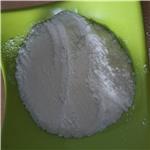
In a 50 mL round-bottom flask, H2O (5.0 g), PEG-400 (1.0 g), and quinoline (1.0 g) were added sequentially. After stirring until homogeneous, W's Pd/C catalyst (0.1 g) was added and the reaction was carried out at 80°C for 20 h. The reaction solution was cooled and filtered. The Pd/C filter cake was washed with water and could be recycled and reused. The filtrate was extracted with ethyl acetate, the solvent was evaporated, concentrated, and crystals were precipitated to obtain the crude product. Recrystallization yielded 0.12 g of white 2,2'-biquinoline crystals, with a yield of 11.9% and a melting point of 196-197°C.
SLIGHTLY YELLOW TO LIGHT BEIGE SHINY FLAKES
2,2'-Biquinoline is used as a reagent for spectrophotometric determination of Cu and as an indicator for titration of organolithium reagents, giving yellow-green charge-transfer complexes.
2,2'-Biquinoline, also known as cuprous reagent, reacts with monovalent cupric ion to give a purple color. It is a highly selective reagent for the determination of cuprous. It can be utilized as a ligand in the synthesis of heteroleptic Cu(I) complexes for light-emitting diodes(LED) and cationic iridium(III) complexes as phosphorescent dyes for live-cell imaging.
2,2′-Biquinoline is a white crystalline solid and it melts at 176°C. It is insoluble in water, but is soluble in ethyl, amyl and isoamyl alcohol, isoamyl acetate, dimethylformamide, acetic acid, acetonitrile and carbon tetrachloride.
Decolourise 2,2'-biquinolyl in CHCl3 solution (charcoal), then crystallise it to constant melting point from EtOH or pet ether [Cumper et al. J Chem Soc 1188 1962]. [Beilstein 23/10 V 8.]