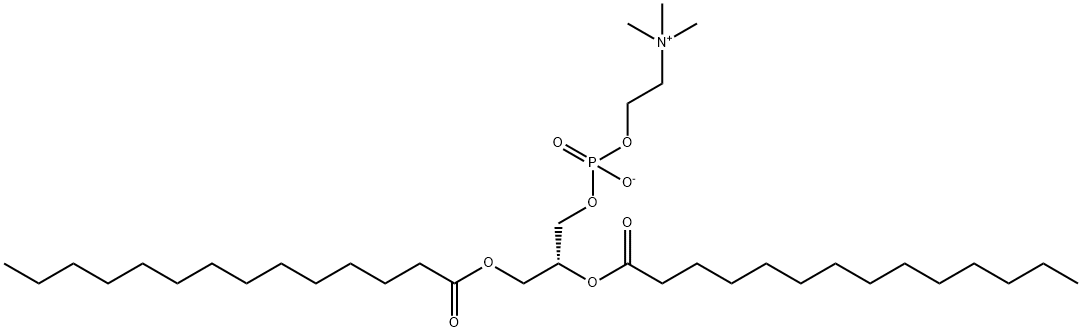
Myristic acid, glycerylphosphatidylcholine, 1-ethyl-(3-dimethylaminopropyl)carbodiimide hydrochloride, and 4-dimethylaminopyridine were added to a dry reaction flask. N,N-dimethylformamide was then added as a reaction solvent. The resulting reaction mixture was stirred at room temperature for several hours, and the reaction progress was monitored by TLC. After the reaction was complete, ethyl acetate and water were added to the reaction mixture for extraction. The two phases were separated, and the aqueous layer was extracted three times with ethyl acetate. All organic layers were then combined. The combined organic layers were washed once with water and once with brine. The organic layers were then dried with anhydrous sodium sulfate, filtered to remove the drying agent, and the filtrate was concentrated under reduced vacuum to obtain the target product, Dimyristoylphosphatidylcholine (DMPC).

1,2-Dimyristoyl-sn-glycero-3-PC (DMPC) is a phospholipid containing 14:0 fatty acids at the sn-1 and sn-2 positions. It is a synthetic phosopholipid that has been used for liposome production in order to study the properties of lipid bilayer.
1,2-Dimyristoyl-sn-glycero-3-phosphocholine has been used as a standard for phospholipid analysis by LC-ESI-MS.
1,2-dimyristoyl-sn-glycero-3-phosphocholine is a phospholipid containing 14:0 fatty acids at the sn-1 and sn-2 positions. It is a synthetic phosopholipid that can be used for liposome production in order to study the properties of lipid bilayer.[Cayman Chemical]
ChEBI: A 1,2-diacyl-sn-glycero-3-phosphocholine where the two phosphatidyl acyl groups are specified as tetradecanoyl (myristoyl).
1,2-dimyristoyl-sn-glycero-3-phosphocholine is a synthetic phospholipid used in liposomes and lipid bilayers for the study of biological membranes.
Phosphatidylcholine (PC) functions as a surfactant within the mucus to form a hydrophobic surface to inhibit bacterial penetrance. It is used to treat fat embolism. Phosphatidylcholine lowers the levels of cholesterol and triglycerides.
It has three forms 1, 2 and '. Recrystallise it from aqueous EtOH or EtOH/Et2O. Its solubility at 22-23o in Et2O is 0.03%, in Me2CO it is 0.06% and in pyridine it is 1.3%. [Baer & Kates J Am Chem Soc 72 942 1950, Baer & Maurakas J Am Chem Soc 74 158 1952, IR: Marinetti & Stotz J Am Chem Soc 76 1347 1954.] The S-isomer with 1H2O is recrystallised from 2,6-dimethylheptan-4-one and has m 226-227o (sintering at 90-95o), and [] 20D -7o (c 6, MeOH/CHCl3 1:1). [Baer & Martin J Biol Chem 193 835 1951, Beilstein 4 IV 1463.]
[1] AKIKO UEMURA. Induction of immune responses against glycosphingolipid antigens: comparison of antibody responses in mice immunized with antigen associated with liposomes prepared from various phospholipids.[J]. Journal of Veterinary Medical Science, 2005, 67 12: 1197-1201. DOI:
10.1292/jvms.67.1197[2] P MéLéARD. Bending elasticities of model membranes: influences of temperature and sterol content.[J]. Biophysical journal, 1997, 72 6: 2616-2629. DOI:
10.1016/s0006-3495(97)78905-7[3] JOHN F. NAGLE Stephanie T N. Structure of lipid bilayers[J]. Biochimica et Biophysica Acta (BBA) - Reviews on Biomembranes, 2000, 1469 3: Pages 159-195. DOI:
10.1016/s0304-4157(00)00016-2