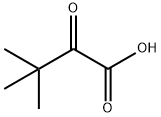
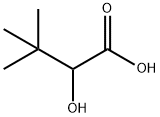
The general procedure for the synthesis of trimethylpyruvic acid (DOBA) from 2-hydroxy-3,3-dimethylbutyric acid (DHBA) is as follows:
1. dissolve 0.1 mol (13.2 g) of 3,3-dimethyl-2-hydroxybutyric acid (DHBA) in 100 mL of 5 N sodium hydroxide solution (containing 5 mol NaOH/mol DHBA).
2. 5 x 10^-4 mol Bi(NO3)3/mol DHBA was added as an additive and the reaction mixture was heated to about 100 °C at atmospheric pressure in the presence of 1 g of activated carbon containing 5 wt. % palladium (pharmaceutical charcoal) until about 1,300 mL of oxygen (about 0.535 mol O2/mol DHBA) was absorbed.
3. The reaction times and results of 3,3-dimethyl-2-oxobutyric acid (DOBA) yields determined by polarography are summarized in Table 2.
Following the procedure of Example 1, 0.1 mol (13.2 g) of 3,3-dimethyl-2-hydroxybutyric acid (DHBA) was dissolved in 100 mL of sodium hydroxide solution at various concentrations, 5 x 10^-4 mol Bi(NO3)3/mol DHBA was added as an activator, and the reaction was carried out in the presence of 1 g of activated charcoal containing 5 wt. % palladium at 95 °C and atmospheric pressure until about 1,300 mL of oxygen (about 0.535 mol O2/mol DHBA) was absorbed. The reaction time and DOBA yield results are summarized in Table 3.
Example 16 is a control experiment in which no super stoichiometric base was used.