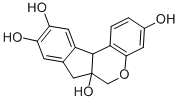
Brazilin is an isoflavonoid originally isolated from
C. sappan that has diverse biological activities, including neuroprotective, anti-inflammatory, antibacterial, and antioxidant properties. Brazilin inhibits Aβ (1-42) fibrillogenesis (IC
50 = 1.5 μM) more potently than (-)-epigallocatechin gallate , cucurmin , and resveratrol. It also prevents remodeling of mature Aβ (1-42) fibrils. Brazilin inhibits the production of cytokines, including PGE
2 and TNF-α (IC
50s = 12.6 and 87.2 μM). It is effective against Gram-positive and Gram-negative bacteria with MICs ranging from 31.3 to 250 μg/ml. In addition, brazilin inhibits osteoclast differentiation mediated by RANKL and is protective against LPS-induced osteoporosis in mice at a dose of 100 mg/kg.

Brazilin family of natural products.